Martin Kaufman was an influential figure in Reading’s gay liberation movement in the 1970s, and over 50 years later, he shares how he’s working with the University to ensure that the bravery of those people – who stood up for the rights of all those who were stigmatised over their sexuality – is not forgotten.
We are excited to announce that Martin will be our guest speaker at Reading’s flagship LGBTQIA+ event, the Wolfenden Lecture, taking place on Thursday 26 February 2026 in the Edith Morley Building on Whiteknights campus.
Entitled ‘Reading Coming Out’, Martin will be talking about how he and others started up the gay and lesbian rights movement in Reading – including holding the very first public gay meetings and events.
Find out more and book your tickets now.
Martin sat down with CONNECTED to talk about his transformational journey at Reading, and how he helped found the Reading Gay Alliance.
Vivid memories
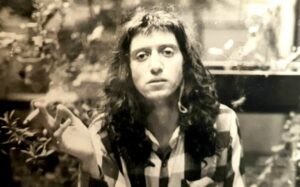
Martin came to Reading to study history of art at postgraduate level and was taught by the late Professor Kerry Downes OBE (who rediscovered Nicholas Hawksmoor, one of the greatest English Baroque architects). He was the first and only postgraduate student taking this subject at the time.
He recalled: “I have always been enthusiastic about history and architecture, and I learnt a fantastic amount whilst at Reading. The experience was absolutely marvellous. I have so many vivid memories of my time there because it was always so full of frenetic activity.
“Many of my favourite memories stem from my time living in Sibly Hall. Sadly, Sibly is no longer standing, but I loved it – there was a great community and the Friday night disco in the Students’ Union was almost obligatory!
“A stand-out moment for me was taking part in the St David’s Hall ‘Carouse’, which was the annual Christmas revue held at London Road. In my first year I did a cabaret in the Great Hall, and in my second year I performed as Widow Twankey from Aladdin, both in drag. In my third year I was part of the first public performance by The Moodies, a group of cabaret performers who later found fame in the 1970s.
“It was a really interesting time for me to be at the University as the spirit of the 1960s started to become mainstream.”
Memorable moments
Martin described the transformative time in his life whilst at Reading, where he became involved in the Gay Liberation Front (GLF) and helped found the Reading Gay Alliance.
He said: “The GLF was formed in 1970, after the New York Stonewall riots in June 1969. I came out in 1969 while at Oxford University, and arrived in Reading in 1970, so I’d only been out for about a year around the time the GLF was created.
“I began to be aware of London-based GLF activities around the spring of 1971. By the time I was in my second year of university, I’d go to the weekly GLF meeting in Notting Hill Gate, which was attended by several hundred people – and I often hitchhiked down the M4 to get there.
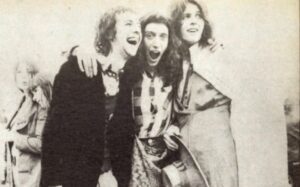
“A memorable moment for me was participating in the first Pride march in the UK with the GLF, which took place in London in July 1972. I joined over 700 protestors when I was 24, and half a century later, I joined the 50th anniversary Pride march in 2022.
“We even managed to recreate a photo taken at the original Pride march.”
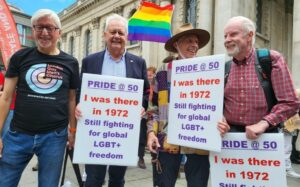
See the photos of Martin at London’s Pride march in 1972 and 2022.
The GLF helped to expand the gay movement around the country, and Martin decided to attend the Reading University Group for Homosexuals, called RUGH which Martin personally pronounced as Rouge.
He said: “I went along to this group one night in a pub in Market Place and found around five people sitting quietly having a drink. It wasn’t at all what I was used to, as our meetings in London were quite loud with a very positive atmosphere.
“I started to bang the drum about the need for us to be more active in Reading. I talked to other friends and contacts at the University – in particular with Goff Sargent who was involved in the Campaign for Homosexual Equality (CHE) and had set up RUGH.
“We decided to set up the Reading Gay Alliance – which I called Reggay – to bring together in the same group those involved in the reformist-style CHE and those in the more rebellious GLF.
“We wanted to break the mould and hold a public meeting at the University. In February or March 1972, we held the very first public meeting about homosexuality in Reading at the University’s Palmer Building, with a prominent guest-speaker Warren Haig from the GLF in London.
“To our amazement, we had about 30 people turn up!”
Following this, Martin discovered that there was a whole network of private gay social events taking place in the town of Reading, but always closeted and out of public view.
He said: “I wanted to help many more people come out, so along with a few others, we planned to hold Reading’s first ever gay dance in June 1972. This took place in St Andrew’s Hall [now the Museum of English Rural Life] and attracted around 60 people, including university students and people from the town. It was groundbreaking. Later that summer, we started the first regular gay and lesbian night at The Railway Tavern opposite the Station.
“I was hoping to celebrate the 50th anniversary of those events but that took place during COVID so it didn’t happen. However, all these and other events will be celebrated at the Wolfenden Lecture in February.
“We can’t let these things be forgotten, because people were very brave in actually stepping up and organising them. Not just me – everybody was courageous to stand up and say: ‘Oh by the way, I’m not like you. I’m gay’.
“One of my favourite badges I used to wear around the University stated: ‘How dare you presume I am heterosexual!’ – I think we need to mark that moment in time.”
Martin was grateful to have felt supported during his time at Reading. He said: “I did have a couple of negative experiences in response to my sexuality, but overall I had a great friendship group around me. My friends in Sibly Hall were very supportive, as were university staff members – I remember one of the librarians lending me a corset when I played Widow Twankey in ‘Carouse’!”
Making dreams a reality
After graduating Martin stayed on living in Reading until the early 1980s, and at the start of the 1990s he fell into a career in fundraising by chance, as a result of rupturing his Achilles tendon whilst dancing the tango.
He explained: “It was quite an exciting way to rupture my tendon I suppose! At the same time, I was made redundant from the magazine I worked for, and my cousin, who was Development Director at Lincoln College in Oxford, said that he thought I would make a good fundraiser. There wasn’t much else I could do with my leg in plaster, so while I recuperated I joined my cousin in Oxford and he taught me the basics of charity fundraising. I’ve now got 35 years’ experience working with some amazing donors and charities to build sustainable relationships that, I believe, have changed the world in many ways.
“I love my work now as a consultant, having the opportunity to make people’s dreams a reality – literally. I’ve learnt an enormous amount about the power of philanthropy.”
While it has been a few decades since Martin attended the University of Reading, he hasn’t forgotten how life-changing his time here was – and he has remained an active member of our community ever since.
He said: “I’ve given advice to a previous Vice-Chancellor about setting up a development function and offered fundraising training to the Development Teams over the years. But my favourite connection has been with the volunteer tours for the Friends of the University of Reading, which I have led for the past 13 years. Two of my tours this year were to the Arcadian Thames in South West London, where I took a group of about 20 of The Friends. I’ve also led tours for them of the London Docklands – from Wapping to Tilbury and back again.
“While I was still working full-time, I donated for a number of years to the University because Reading helped to transform my life. I wanted to give thanks and recognition for that.
“In particular, as the University was the site of my gay liberation experience, which was so important to me.
“Ultimately this place changed who I am for the better. I have very warm feelings for this institution, and I am honoured to be asked to give the Wolfenden Lecture.”
Find out more about The Friends of the University of Reading.