As a disability rights campaigner, television producer, author and sign language interpreter for the Grateful Dead – Reading alumnus and Honorary Graduate, Paddy Ladd has spent decades campaigning for the rights and recognition of Deaf communities.
 Born Deaf in 1952, Paddy was one of the first Deaf children in the country to be placed in a mainstream school, in an era when that education system failed many within the Deaf community. Since then, Paddy has dedicated himself to highlighting and improving the experience of the Deaf community as well as celebrating Deaf culture.
Paddy first stepped onto the campus at Reading in 1970 as an English literature undergraduate. He shared:
“I loved English literature. As a Deaf student I had minimal access to lectures because there were no interpreters or notetakers back then, so I figured with English literature I could always focus on the texts themselves.
“Studying at Reading widened my perspective on life and helped me to develop my own thinking.”
Paddy found that there was even more to be learned outside of the lecture theatre, including working with the town’s anarchist group ADE, to develop community activities. He recalled:
“I was lucky to be alive and attend University while the visions of the 1960s were still real and viable.
All my work since then has been based on those visions – the importance of community, of social justice, and thinking outside the box, were all concepts I explored in those first 3 years at Reading.
“I then applied all that learning to supporting Deaf communities.”
Challenging the status quo
After graduating, Paddy became a social worker for young Deaf people, in a role that would act as the blueprint for his life’s work. He explained:
“I realised the scale of the educational oppression of the young Deaf people I was working with. Sign languages were banned since the 1880s under a system called Oralism, which unfortunately persists today. This aimed to remove anything ‘Deaf’ from Deaf education: Deaf teachers, community, arts, history, culture, Deaf Studies, et cetera.”
This realisation led Paddy into action. He added:
“I co-founded a Deaf pressure voluntary group to change this situation.
“At the National Union of the Deaf, we also campaigned for British Sign Language (BSL), and Deaf-run television, making the first Deaf-led TV programme, Signs of Life. All the signing you see today on TV can be traced back to this.”
Paddy then moved from social work to help transform the British Deaf Association (BDA) into a more politically-oriented body:
“This involved providing BSL at party conferences, continuing to challenge Oralism, and working to support recognition of BSL as a language.”
He also helped organise a week-long protest at the International Congress on Education of the Deaf in Manchester. He recalled:
“It was an important moment for us, challenging the Oralist-run Congress through our protests and action – we even made it onto the 6 O’clock News.”
His next move was to the BBC where he worked to transform the Deaf TV programming. It was here, in 1982, that Paddy helped launch the BBC’s very first Deaf programme series, See Hear.
This time wasn’t without its challenges, as Paddy shared:
“I was the only born-Deaf person there and the stress of this led me to quit after 3 years and to set up the UK’s first Deaf-run organisation affiliated to the BDA, the London Deaf Video Project (LDVP).”
Funded by Ken Livingstone’s Greater London Council, the LDVP aimed to translate government information and other subjects into BSL, something which, at the time, was unprecedented. In recognition of this groundbreaking work, on 14 January 1992, the LDVP received a very special visit. Paddy recalled:
“A highlight was when Princess Diana visited us at the LDVP. As a patron of the BDA, she had really helped highlight the work we were all doing.”
Paddy remained committed to using activism to create change for the Deaf community. In 1998, he helped set up a new organisation called the Federation of Deaf People (FDP). He said:
“A major aim of the FDP was to organise the first ever Deaf marches in the UK for formal recognition of BSL.
“I was proud to help organise the first march in 1999, and we kept this up for several years, with local and national marches, until in 2003 we got very token government recognition – so that’s a battle that’s still ongoing.”
Championing Deaf culture
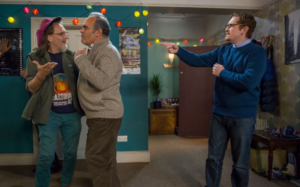
Paddy also began to raise awareness about the concept of Deaf culture and in 1987 was a lead actor in the Channel 4 film, Pictures in the Mind, about the history of Deaf education, Oralism and the newly emerging bilingual, bicultural model of education.
Paddy explained: “The concept of Deaf culture was beginning to emerge in the late 1980s, but nobody knew what it really meant, so I decided that was the next priority to tackle. I was already utterly fascinated by the concept of culture in general – still am – and had done a Masters in Cultural Studies in London.”
Tackling this priority first led him overseas where, in 1992, he began to compare UK and US Deaf cultures at Gallaudet, the Deaf university in Washington DC.
On returning to the UK, he began to build a framework for understanding Deaf culture for his PhD at the Centre for Deaf Studies (CDS) at the University of Bristol. It was here that he developed the concept of Deafhood, which had a huge impact around the world.
In 1999, he created the Blue Ribbon Ceremony for the 13th World Federation of the Deaf Congress. He explained its significance:
“This sought to reintroduce Deaf spirituality dimensions into Deaf cultures and celebrate the achievement of the world’s Deaf communities.”
In 2003, Paddy published his seminal work, Understanding Deaf Culture: In Search of Deafhood. The book, which has been translated into seven languages, explores the historical, cultural and linguistic realities of Deaf communities, showing that their positive identities should celebrated, not seen as something to be cured.
“One aim of Deafhood is to heal the Deaf communities from the effects of their educational oppression – to rebuild their confidence and develop the strength to challenge oppression.”
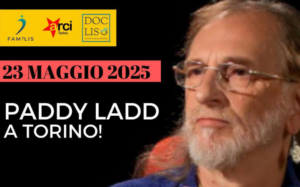
In the ensuing years, Paddy has taught Deafhood in countries worldwide:
“It has been so fulfilling to see the concept empower so many people around the globe.”
A respectable rebel
After completing his PhD, Paddy began work at the CDS.
“I spent the next 20 years at that Centre in Bristol, where I helped develop the postgraduate programme, created the UK’s first Deaf-led research projects, the world’s only Master’s in Deafhood Studies, and eventually became a Reader”.
He is currently writing the first ever books on Deaf pedagogies and the histories of Deaf teachers in the UK, US and France.
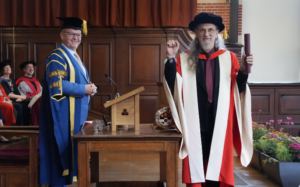
In 2026, Paddy returned to Reading to accept the Honorary degree of Doctor of Letters in a ceremony on Wednesday 22 July. He shared what the day meant to him:
“It gave me a feeling of closure, with the added irony of having been one of the rebels back in the day, but now being seen as ‘respectable’, without having compromised my beliefs in the intervening 50 years.
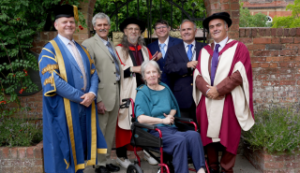 “But above all it enabled me to publicly thank my friend, Professor Viv Edwards, for her years of support and stimulation, by having her and her husband Chris attend the ceremony. Her groundbreaking work on minority languages and cultures enabled me to clarify how this applied to Deaf communities also.”
Paddy reflects how Reading has always been a significant part of his story and continues to guide him:
“All through this time I have also had a parallel life, again influenced by the 1960s and Reading.
“I have the vision that we can bring Deaf children’s oppression to public attention – and show hearing people the beauty of sign languages and Deaf life through creating Deafhood Signed Songs written, performed and filmed by Deaf people. This would also act as a bridge between Deaf and hearing worlds.”
This vision is something that Paddy is hoping to realise through the publication of two other books. The first is a musical called Signs Of Freedom and the second is a book of 80 songs for live concerts: Songs Of Deafhood.
Music for everyone
Music has been an important part of Paddy’s life and work. Even as he gradually lost the rest of his hearing, he has fought to improve Deaf access to music. Paddy shared:
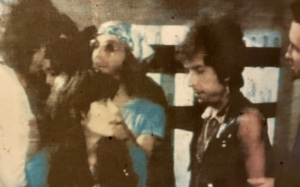
“This began with co-creating the US Deafzone in 1990, to enable signed access to Grateful Dead-related concerts with the band’s support.”“I then became one of the first Deaf concert interpreters, touring with the Grateful Dead, and have also signed at concerts by Bob Dylan and Bruce Springsteen.”
Then in 2009, after 20 years of perseverance, Paddy created the UK Deafzone, which established a growing presence at the UK’s biggest and most renowned music festival, Glastonbury:
“Our aim was to provide a cultural exchange: teaching hearing people BSL and Deaf culture and providing interpreters for Deaf folks.
“Last year, our voluntary team was around 50-strong, including 25 interpreters.”
Sign of the times
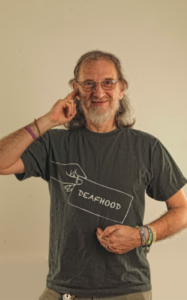 For over 50 years, Paddy been an instrumental part of vital improvements to accessibility and visibility for Deaf communities. But he stresses that the fight is far from over:
“Oralism is still rampant and parents continue to be deliberately misled about the value of BSL, and the policy of mainstreaming Deaf children to isolate them from each other has also resulted in the closure of so many Deaf schools.
“As a consequence, acquired mental ill health is double that of the rest of the population.”
But there’s much to be proud of in terms of what has been achieved, as Paddy adds:
“Now that we have dismantled so many barriers, our young Deaf people have many career options. Although there’s still a long way to go to achieve equality at the higher levels.”
Advice in the face of adversity
Paddy hopes that the work he and his colleagues have done will inspire more Deaf youth to embrace their Deaf identity and use their strengths to be a ‘voice’ for their communities:
“Once I recognised my own Deaf identity, I used my privilege as a Deaf person with some speech and English skills to first take a step back, look at the ‘Deaf Nation’ as a whole and see what areas needed to be prioritised, and then dive in and make changes. And then move on to the next area that needed to be tackled!
“To do all this, it is important to involve hearing people as active allies.”
Paddy offers the following advice to anyone facing adversity or wanting to enact meaningful change:
“Develop a clear vision of what you want to achieve, seek out like-minded people, and plan carefully. Learn to work together with kindness and positivity – and help colleagues to avoid burnout.
“But above all, don’t be afraid to think outside the box.”
If you would like to find out more about Deafhood SignSong, particularly if you are a musician who may be able to help with this project, please visit the website and get in touch.