

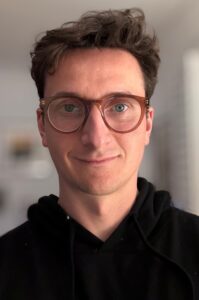
Film, Theatre and Television graduate, James Ratee, has built a career telling stories that bring people’s experiences to life. Now a producer and director at Bloomberg – James shares the creative journey that led him to the Emmys.
From making short films as a child to producing documentaries for Bloomberg, James has built a career around telling stories in creative ways. Reflecting on his time at the University of Reading, where he completed a BA, MA and PhD in Film, Theatre and Television (FTT), before returning as a visiting lecturer, James shares how the University gave him the imagination, practical skills and confidence to build a career in documentary filmmaking.
Finding a creative community at Reading
 When James first began looking at universities, he knew he wanted to combine two interests that had been developing since his school days: film and theatre. He shared:
“I took drama A level way, way back in the day, but I was also really interested in film. So I was looking for university degrees that combined both subjects. I had more of an interest in film, but I had never really studied it before.”
And, Reading stood out immediately for James. “The FTT department had a really good reputation – so, academically, I knew it would be a good place to study. Then when I went to a University of Reading open day, I really liked the course structure and the vibe of the lecturers.
“I liked the idea that you got to make stuff and write about it as well – I really loved the idea of doing both.”
James went on to spend eight years at Reading, completing his BA in 2008, MA in 2009 and PhD in 2013.
With so many years at the University, there are plenty of memories to choose from. One of the things that stood out most to James was the sense of community within the FTT Department. He shared:
“The standout memory for me was the sense of family the department had. You got to know your fellow students really well, both in terms of friendships and working together professionally – which is really helpful for the future.
“It’s a really beautiful feature of the department that you get to know both your lecturers and your fellow students really well.”
The practical nature of the course also created opportunities to work closely with others on creative projects. James remembers the long evenings spent working:
“It sounds stressful – the late nights when everyone has already gone home -but those are some of the most creative and most rewarding moments. And, getting to work with someone else on a shared passion project and making it come to life – those are the moments that form lasting memories.”
James’s relationship with Reading changed from student to lecturer during his PhD when he was asked to teach a Critical Practice module. He recalled:
“I was nervous as I had no experience, but I said I’d give it a try.”
“I had massive imposter syndrome, but once I started doing it and found the students listened to me as though I was a voice of experience and expertise, I found I really enjoyed it.”
The experience also gave him a new appreciation for the one-to-one relationships involved in helping students develop their own creative ideas.
“I really loved helping the students fulfil a project they felt passionately about.”
A different route into filmmaking
During his PhD, James had also began to explore different routes into the film industry – working first as a runner at an editing house where he was responsible for making tea, preparing rooms and organising lunches for editors and producers.
“I didn’t particularly enjoy it,” he recalled. “I think to be good at that, you need to be very good at networking and putting yourself out there. And I was really shy at that stage. So I felt like I was going to be making tea forever if I stayed.”
Instead, his career evolved through a series of stepping stones.
Pivoting away from work as a runner, James began making films alongside his research – including videos for businesses such as fireplace showrooms and garages. While these projects were far removed from the documentaries he would eventually produce, they gave him valuable practical experience. He shared:
“You turn up and you just have to make do with the fireplace showroom and make it look really beautiful. You have to work with the manager who may never have been in front of a camera before.
“Because I did those shoots alone, I had to learn how to operate the camera and manage the shoot entirely by myself. It was a real learning curve.”
Then, after graduating from Reading, James took a position at the London School of Economics and Political Science (LSE) University. “My job was to make documentaries and films about the different research projects that lecturers were undertaking there at the university,” he explained.
“I really loved that job. It was around then that I realised how much I enjoyed the practical, hands-on side of the work — actually being out there making films — and that’s what I wanted to build a career around.”
James began looking towards organisations such as Vice and Vox, drawn to their approach to documentary and explanatory storytelling. Eventually, he turned his attention to Bloomberg.
However, getting there took persistence. He shared:
“I applied once and I didn’t even get an interview. Then I applied again around a year later and was successful.
“I don’t know what the difference was the second time around – maybe I had more confidence, or the skills I gained since my last application made a difference. Maybe it was just someone different who had read my CV the second time. Who knows – but I’m so glad I didn’t give up and kept trying.”
James initially worked more heavily on the news side, producing shorter films, before gradually moving towards documentary production. He said:
“I slowly gravitated towards the documentary side of things – that’s where my passions and my skills lie. So now I’m firmly in the documentary team.”
Today, James works as a producer and director, creating documentaries, news pieces and other forms of visual storytelling.
His work has taken him to organisations and projects around the world, with clients and collaborators including UNICEF, the Fitzwilliam Museum, the Arcola Theatre, Glastonbury Festival, Battersea Arts Centre, the Novak Djokovic Foundation, BBC Radio 6 Music and Cambridge University.
The Emmys
 For James, the attraction of documentary filmmaking lies in its ability to give audiences access to lives and experiences which they might otherwise never encounter.
“You can get into different people’s worlds. I’ve worked on projects as diverse as prisons and remote places in Indonesia – it’s incredible to be able to share such vast lenses into others’ lives,” he explained.
“I have a passion for telling stories in creative ways and I think that’s down to my training at Reading. It ignited my imagination.”
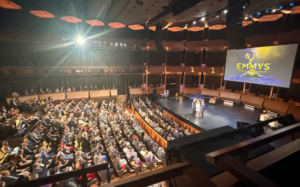
That passion has taken James to some remarkable projects, including all the way to New York for personal recognition at the Emmys for his work on the documentary, The Hidden Cost of South Sudan’s Oil Boom.
The Bloomberg Originals documentary explores South Sudan’s reliance on oil and allegations from communities living near oil fields that polluted water is contributing to serious health problems.
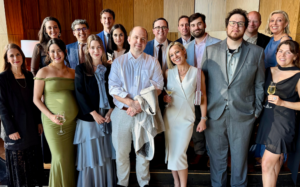 This year the documentary was nominated for a News and Documentary Emmy Award for outstanding graphic design. Of receiving the nomination, James shared: “I was really delighted and thrilled to be nominated for the Emmy award!
“I’ve been nominated for smaller things over the years, but to be nominated for the Emmys felt like a dream.
“To go to New York for the ceremony and to see the red carpet – it was all very surreal.”
Producing the documentary however wasn’t without its challenges. He shared: “I’m only one cog in a team production. It takes a lot of trust building from the reporter before we can even go to these places to film.
“You need to remember that the people who are sharing their stories for us to film probably haven’t seen the work we’ve done before. It takes a huge amount of trust from them that we will do a good job and accurately tell their story.
“There are also lots of technical things that need to be factored in. These include making sure the translator is doing a good and ethical job of translating the piece and finding the bits of dialogue where it can tell the story without causing any legal issues. It can be very complicated but it’s really rewarding too.”
For James, visual design is much more than decoration. Graphics and animation can help audiences understand stories that cannot easily be captured through conventional footage.
“It’s a powerful form of storytelling,” he shared. “You can express things that happened in the past in a way that you otherwise couldn’t visually show. Animation can help express that point of view.
“It’s a real privilege to work on stories that are really important and need to be shared.”
Advice for others
For those currently hoping to build careers in film, television or documentary production, James emphasises that there is no single route into the industry.
“Try to remember that there are multiple ways into the industry that don’t include just being a runner on a set.
“Even if you need to take a non-media related job in the meantime, have your own personal projects going on in the background. Keep working and enjoying what you’re doing. Make stuff and don’t give up after one application!”
Looking ahead
James continues to develop new documentary projects with Bloomberg. His latest project, Trump’s Immigration Raids Have an Unexpected Price Tag, documents the social and economic impact of Immigration raids in Charlotte, North Carolina.
Watch the Emmy nominated documentary, The Hidden Cost of South Sudan’s Oil Boom:
Find out more about Film, Theatre and Television at the University of Reading