
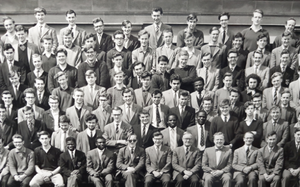
John Grainger first joined Reading and the Department of Microbiology in 1957 to work on his PhD – marking the start of an unbroken relationship with Reading that still remains almost seven decades later.
From PhD student to Head of Department, educator, volunteer and 2026 Celebration of Volunteering award recipient, John’s connection with the University of Reading spans almost 70 years. Having forged lifelong friendships and found love – Reading still holds a dear place in his heart.
Early academic experiences
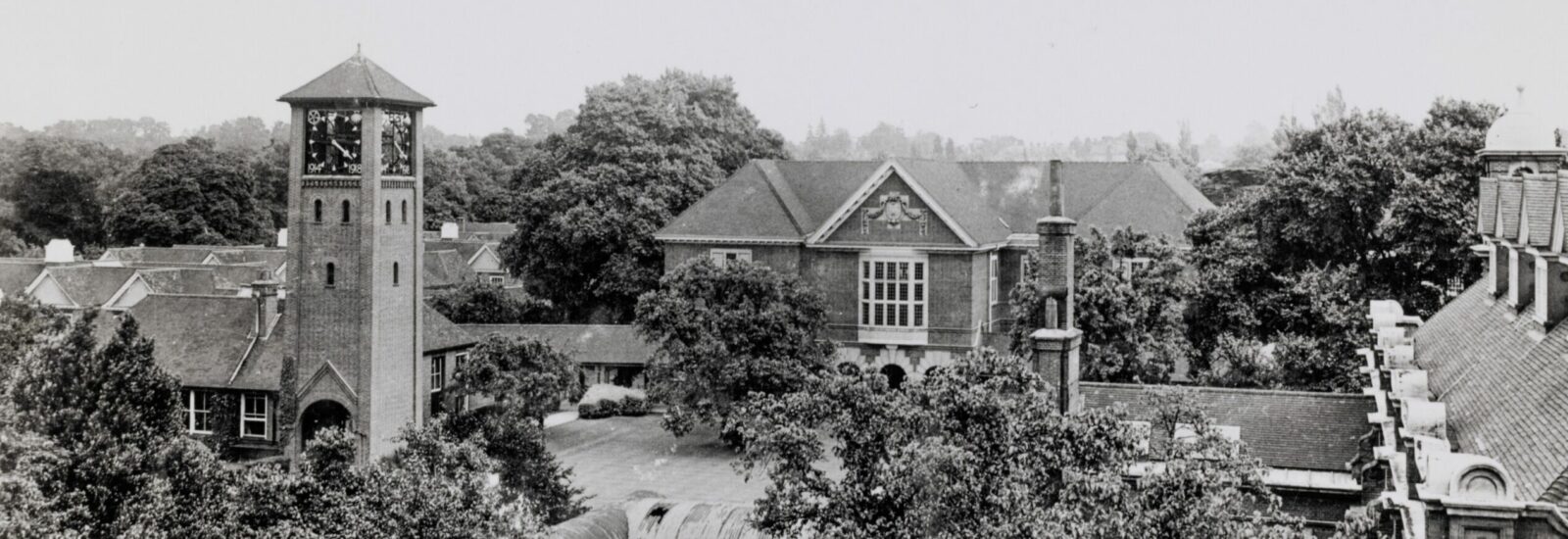
 John began his PhD studies in the Department of Microbiology at the London Road campus, then known as the ‘Main Site’. Whiteknights Park had only recently been purchased in 1947 and by the late 1950s was still in the early stages of development with only a handful of academic buildings in use. London Road was a close-knit campus. Students, postgraduates and administrative and technical staff would regularly gather in The Buttery, a wooden building near the Great Hall that remained a social hub until it was destroyed by a fire in the 1980s.
Reflecting on the academic environment surrounding him, John reminisced: “It is astonishing that in my early days at London Road, six of the departments in science and agriculture were headed by a Fellow of the Royal Society who we saw regularly in the cloisters. The Department of Microbiology was innovative in being the first university department in the UK to be named such.
“Its Foundation Professor, BCJG Knight, appointed in 1951, was of such high international standing that his visitors book carries the signatures of seven Nobel laureates — including Alexander Fleming of penicillin fame.”
John recalled that, at the time, the Whiteknights campus rarely featured in his routine: “My only reason to go to Whiteknights was to register at one of a network of government ‘Temporary Office Buildings’ [TOBs] on Earley Gate to secure exemption from National Service in order to complete my PhD.”
Building a distinguished career
Following his PhD, John was appointed Lecturer in 1961, teaching microbiology to both science students and food science students whilst conducting his own research in food, agricultural waste and municipal refuse. He said: “I greatly enjoyed teaching but as time went by, I was drawn into additional roles by the Faculty of Science, Senate and Council.”
During the 1970s, John pioneered safe practice in microbiology programmes for schools and promoted biotechnology at a time when the field was developing rapidly. The delivery of these programmes became possible on a national basis through support from the Microbiology Society, which John represented on the Microbiology in Schools Advisory Committee (MiSAC), of which he remains chair today. This outreach developed even further as John secured government and industry funds to establish the National Centre for Biotechnology Education (NCBE) at the University in 1985. He was also closely involved in creating the European Initiative for Biotechnology Education (EIBE) with funds from the European Commission which from 1992 to 2002 grew to involve 17 countries.
 In recognition of his leading outreach work over many decades, John has received several awards, including the Peter Wildly Prize in 2002 for Education in Microbiology, the 2018 President’s Medal from the Royal Society of Biology, and in 2019 was appointed to MBE in the Queen Elizabeth II’s Birthday Honours.
In 1972, John was promoted to Senior Lecturer and in 1989 became Head of Department. Reflecting on this period, he said: “A great deal happened during my period of headship. The department moved to a new building in Whiteknights, now called the Knight Building.
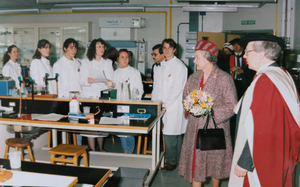
“We were also ranked one of the top two departments in the Microbiology section of the Research Excellence Framework and we welcomed HM Queen Elizabeth II to open the new Microbiology building.”
Milestone memories
John considers his career at Reading to have been a most fortunate and privileged experience. Although the first 34 years of his time were spent ‘down the hill’, many lasting relationships were made at Whiteknights, aided by non-academic events such as playing tennis, squash, badminton and football. Nevertheless, London Road – and particularly the Great Hall – hold his dearest memories.
John’s recollections of the Great Hall range from his more formal responsibilities as Chief Invigilator for Examinations and as marshal of academic staff processions at degree congregations, to more social affairs such as rock concerts, dances known as ‘hops’, and the Vice-Chancellor’s Ball. He joined the Choral Society which rehearsed and performed there, and their major events included performances of JS Bach’s, Passions, where leading soloists such as Dame Janet Baker and John Carol Case were engaged.
He fondly recalls one of Reading’s past student traditions: “Older alumni will remember the rush to buy tickets for Jantaculum, held every December in the Great Hall. ‘Jantac’ was devised in 1897 as a joint staff and student activity by WM Childs who was our first Vice-Chancellor after gaining the Royal Charter. It was then held annually for the next 90 years. I was invited by the student committee to be Reeve or chairman in 1964 and 1966. It was a demanding role but thoroughly enjoyable.”
John added that from 1962 to 1968, he lived in St Patrick’s Hall as one of six Senior Residents:
“It was my first experience of collegiate life and a period that I thoroughly enjoyed and benefited from. As a young academic, I was grateful to learn much from the wide range of fellow resident colleagues and non-resident members of the Hall SCR (Senior Common Room) who were experienced in University matters. Also, a system of Hall Tutors introduced me to a wide range of students – probably a factor in my involvement with ‘Jantac.’”
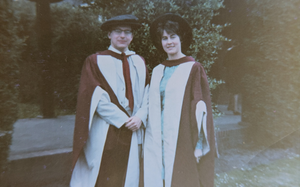 John’s most significant personal milestone also occurred at London Road where he met his future wife, Gillian Roberts.
John reminisced: “In the 1960s, Gill was in the practical classes that I supervised. She continued to focus on Microbiology and after graduation gained a PhD in microbial genetics and was appointed to a lectureship. We were only distantly acquainted during those days as our social circles were very different until, nearing the completion of her PhD, we both attended an international microbiology conference in Moscow. During the long sea voyage to and from the conference a closer relationship developed. We married in 1968”.
John added:
“Another connection with Reading is already in hand; one of our grandchildren will be graduating in 2027.”
Staying connected
In retirement, John and Gill remain connected with the University through their membership of The Friends of the University of which John is a trustee. The Friends was established in 1927 to foster ties between members of the newly established University and the local community. The Friends host talks, tours and visits, and produce University heritage leaflets and provide grants for projects through members’ subscriptions.
For his work on the heritage leaflets, John received the 2026 Alumni and Supporter Volunteer of the Year Award jointly with his fellow Friend, Ian Burn.
Find out more about our Alumni and Supporter Volunteer Award winners
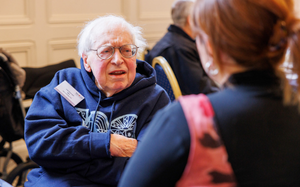 John and Gill also attended the afternoon tea held as part of alumni activities for the Centenary Community Festival. The event brought together alumni from different decades to show appreciation to graduates and academics such as John, whose distinguished story we are privileged to say will forever be a part of ours.
Membership of The Friends is open to anyone with an interest in supporting the University and preserving its rich heritage.
Find out more about joining The Friends
Do you have memories of your time at the University you would like to share? If so, email us at alumni@reading.ac.uk