“You can’t be what you can’t see.” Bishop Rachel Treweek shares how her time at the University of Reading helped shape her journey to becoming the first female Diocesan Bishop in the Church of England – and why representation in leadership matters.
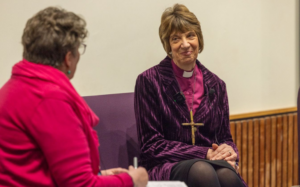 At 14, Rachel didn’t know what a speech and language therapist was. Whilst growing up, she had imagined a future in teaching or medicine. But a chance suggestion from a family friend changed everything and a visit to Hackney Children’s Hospital introduced her to a profession she had never encountered – and immediately felt drawn to.
She shared: “I’m quite a determined person, so I set my sights on speech and language therapy as a career even without fully knowing everything about it. I liked that it seemed a bit different – something no one else was talking about. There was something medical about it, but also quite teacher-y – and I loved working with children.”
Determined and curious, Rachel’s path was set.
Choosing Reading
In the late 1970s, only five universities in the UK offered degrees in speech therapy. Each had a slightly different focus but for Rachel, Reading stood out.
“Reading had such a strong reputation for linguistics, and the programme had a medical side element. And of course Professor David Crystal was there. I applied to all five of the universities and was offered a place at all of them – but Reading was my number one choice.”
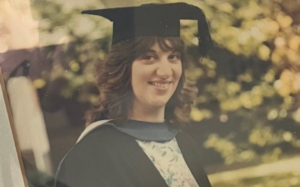 The decision wasn’t only academic. When Rachel visited, the campus made a lasting impression. She shared: “I loved the campus – the green spaces and the lake. I’ve always loved the outdoors, and that really mattered.”
For Rachel, life on campus was both rewarding and demanding. She recalled: “The linguistics and language pathology course was intensive. It was much more like being a medical student – starting at 8:30 in the hospital, cycling back for lectures, and often not finishing until five or six.”
That intensity shaped her experience. While others had time for clubs and societies, Rachel’s course left little space for extracurricular activities but offered her something invaluable.
“I loved that I was at university but already out in the real world – working in hospitals and schools,” she shared.
“I have so many memories of that early morning walk over the campus and past the lake – whether it was misty, foggy or sunny and seeing the change across the different seasons.
“I also remember having to figure out how to navigate a new environment – feeling lonely in a crowd at times and meeting people with very different views. But that’s the great thing about university – it does form you and shape you.”
With a small cohort of just 12 students, strong friendships formed quickly.
“We had a really tight-knit group. We knew how demanding the course was and we really did support one another through it,” she recalled.
Stepping into the real world
After graduating, Rachel began her career as a paediatric speech and language therapist in Gospel Oak, inspired in part by Dr Lena Rustin, a visiting lecturer at Reading.
She explained: “Dr Rustin, who was an eminent speech and language therapist, would visit Reading annually and would do management training with us. She was terrifying – but I admired her. She really challenged and pushed us out of our comfort zone.
“I learned so much from her, and I really wanted to work in her team. So, I deliberately applied for an initial speech and language post in her area.”
Working in a challenging inner-city environment, Rachel quickly found her footing. She shared: “It was a rundown health centre and its windows were always being broken, but I loved it. I had my own caseload, I could organise my work, and I felt like I was really in the real world.”
She later joined the Royal Free Hospital, working within a multidisciplinary team – an experience that shaped her thinking.
“I started to think more systemically – not just about the child, but about the family, the school and the entire network around them.”
It was during this time that Rachel stepped into leadership – managing paediatric speech therapists across multiple health authorities – which led her to train in family therapy. It was also during this time that another calling began to emerge.
“I kept my own case load because I thought it was really important if you’re going to be middle management to still keep your hand in. And, it was around this time that I had my sense of call to ordination,” she explained.
A different calling
Alongside her professional life, Rachel became increasingly involved in her church community in London. Rachel shared: “I had always had faith and was very involved in the Christian Union at Reading and attended a local church.
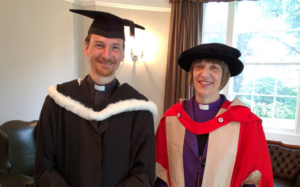 “Around the time I had my call to ordination I was very involved in a church in London which met in a community hall in the middle of a housing estate. I met people from all different walks of life, people in places of struggle, as well as celebration.
“I began to have this sense that perhaps God was calling me to do more in the church – in that place of connection and helping people flourish.”
Encouraged by her vicar, she began exploring ordination – though the decision did not come easily. “I imagined it would happen at the age I am now, not when I was in my late twenties” Rachel laughed.
“Eventually I plucked up the courage to speak to the vicar and he paused and said: ‘I’ve been waiting for you to say that’.”
With that, Rachel said a difficult goodbye to speech and language therapy. She shared: “It was everything I’d wanted to do so leaving it was something I really grieved.”
Yet the themes that had shaped her career remained central as she transitioned from speech and language therapy into ministry in the Church of England.
“I found my families and connections in different ways. Although I was no longer a speech and language therapist, I still lived those themes of connection, relationship, and enabling people to flourish through the church.”
Breaking new ground
Rachel’s journey in ordained ministry in the Church of England took her from parish ministry to senior leadership roles, including serving as a vicar and later as an archdeacon.
“When I first went to theological college, women couldn’t be ordained as priests let alone bishops.” Rachel explained. “I never imagined I would go on to become a bishop – simply because it wasn’t a possibility.”
The first women were ordained priest in 1994, and in 2014, it became possible for women to be ordained as bishops. Soon after, Rachel was appointed as the first female diocesan and became the Bishop of Gloucester. Rachel shared:
When the Gen Synod of the Church of England finally voted in favour of female bishops, I remember a terrifying moment of realisation that it was now possible for this to be me. And not long after, it was.”
Rachel is now one of 42 diocesan bishops, and she explained: “I lead a diocese which means that I am the leader of all the Anglican churches, schools and community projects in the diocese.
“I have a great team of people who lead all those different strands. My job is to lead, to hold us to our vision and to ensure that we in habit it well.”
Within weeks of her appointment, Rachel also entered the House of Lords.
“There are 26 bishops who sit in the House of Lords and five of those always sit there – the two archbishops, the Bishop of London, Durham and Winchester – the other 21 are the longest serving bishops.” She explained.
“Because it wasn’t possible for a woman to be a bishop until 2014, Parliament then passed an Act so that such that when a bishop retired, if there was a female diocesan bishop she would ‘jump’ the queue. I’d only been a bishop for four weeks when a Bishop retired and I went straight into the House of Lords which was a pretty steep learning curve.
“I didn’t really stop to think about it. I just had to keep going.”
Representation and responsibility
Rachel’s presence in the House of Lords was part of a broader shift towards greater representation and for Rachel, the importance of women in leadership goes beyond equality – it shapes outcomes.
“If you don’t have women in the room, there’s something fundamentally missing.” Rachel shared. “We don’t live in a world of just of men or just women – therefore it must be better for the world that we work together.”
She believes diverse voices lead to better outcomes, particularly in areas such as peacebuilding and social policy. She shared:
“When you look at something like President Trump talking about setting up the Board of Peace in relation to Gaza – there were no females mentioned. What actually made me more angry was that no one was picking it up. In the media reports, no one was asking ‘Where are the women?’
“We know that women can have huge impact in peace building and we’ve seen it in effect all over the world in areas of conflict. For me, if you don’t include women, which are half of the population, there’s something really dysfunctional about that.”
At the same time, she acknowledges the pressures women can face in leadership.
“There can be a sense that you have to prove yourself – to do everything better,” she explained. “I remember, in the early days of my ministry, often noticing if a man got something wrong some people would say ‘Oh he’s having an off day’ but if a woman did, it was because she’s a woman.”
Representation, she says, is key to changing that narrative. She shared: “You can’t be what you can’t see. It’s important for women to be seen in leadership positions, as it is to see people from different backgrounds in this roles – it means a child can see you and think ‘Oh, I could do that job’.
“When people see someone like them, it opens up possibilities.”
Although there have been challenges, there have also been moments of unexpected freedom. “There’s an excitement that when you’re the first of something, you can make it up as you go along – even down to what you wear,” Rachel laughed.
“
“And what are we called? Bishops in the House of Lords are referred to as Lord Bishops, so I was asked if I would be ‘Lord or Lady Bishop’ but actually, I decided to be Lord Bishop. There had been such inequality of being called ‘women bishops’ – although you wouldn’t hear ‘man bishop’ such as historically you would hear the ‘woman doctor and the doctor (the man)’. I decided no, a bishop, is a bishop, is a bishop. So if male bishops were called ‘Lord Bishop’ then I too would be Lord Bishop. For me this was akin to Lord Lieutenants being Lord regardless of being male or female.”
Once Reading, always Reading
Looking back, Rachel sees a clear thread connecting her time at Reading with everything that followed. She shared: “Communication, relationship, and human flourishing are all things that have shaped every part of my life. And my time at Reading taught me how to face reality – the joy and the pain – and to have those hard conversations which has really helped me during my work in the Church.”
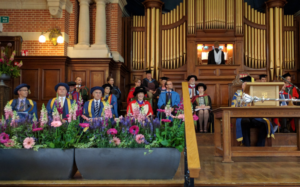 Last month Rachel returned to Whiteknights campus to deliver our annual Chaplaincy Lecture – the first time she had been back since receiving her honorary doctorate in 2016.
She reflected: “It was quite healing coming back. There was something about going out into life and having all these experiences, and then gathering all those fragments of life back up and going back to Reading – it was very special.
“Seeing Professor Susan Edwards was a real highlight for me. She was so influential in my life that when I walked in and saw she was there, I was almost in tears. I recognised her straight away.”
Looking forward
Today, alongside her episcopal responsibilities, Rachel continues to advocate for social justice, including now being the Anglican Bishop for HM prisons in England and Wales, as well as focusing on issues such as violence against women and girls.
Her advice to others wanting to make a difference is simple: “Find what you’re passionate about – what makes your soul sing – and start there.”
And above all, she encourages people to be confident in who they are.
“Don’t question if you’re good enough. The world needs each of us to be who we are.”
Watch the 2026 Chaplaincy Lecture