

From 1946-1966, the University was in a period of growth – expanding its land, buildings and status. We look back at the key moments from these two decades and hear from alumni who studied at Reading at that time.
As part of our year-long edition of CONNECTED celebrating our centenary, we are revisiting defining moments from each decade. In this edition, we turn to 1946-1966 – a time of bold expansion, innovation and lasting change that helped shape the University we know today.
From 1946-1966
At the beginning of 1946, Whiteknights Park entered its “University Era”, as the University of Reading began developing its main campus on the Whiteknights Park site.
Did you know? By the 1940s, the University was facing severe space shortages at its London Road campus. Despite acquiring several nearby buildings such as Hillside, it seemed unlikely that the University would be able to take part in the government’s post-war National Expansion Scheme for higher education.
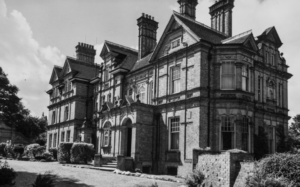
That changed in 1947, when the former Whiteknights Park estate, owned by the Marquis of Blandford, was purchased. In the early years the park was used for student accommodation, and buildings such as Whiteknights Park House, Blandford Lodge and Park House became temporary halls of residence.
The acquisition of over 300 acres of Whiteknights Park solved the University’s space challenges for an almost indefinite period.
Today, Whiteknights remains our main campus, now spanning more than 320 acres. It has received over 15 Green Flag Awards in recognition of its beautiful parkland campus and luscious green spaces.
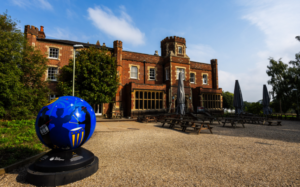
And, you can still visit Park House today – which retains a lot of its original features, but with the addition of a great beer and food selection.
Did you know? In the 1950s, the government constructed Reading War Room 6 near Earley Gate, also known as “The Citadel”. These region war rooms were strategically designed during the Cold War to protect government functions and coordinate defence in the event of an atomic attack.
Region 6 covered Dorset, Hampshire and the Isle of Wight, Berkshire, Oxfordshire and Buckinghamshire.
Today, although not in use due to safety, the War Room still stands and holds a Grade II listing.
Find out more about the Reading War Room
Did you know? In 1950, Professor Harold Hopkins invented the fibroscope – a breakthrough innovation that contributed to the development of keyhole surgery.
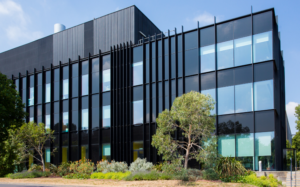
In recognition of his trailblazing work, the University opened the Hopkins Building in 2009. Today, the building is home to the Institute of Cardiovascular and Metabolic Research, a leading centre for the study of heart disease and strokes.
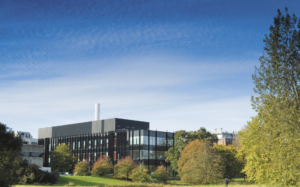
Did you know? In 1950, the first Wolfenden Report was published, playing a pivotal role in the decriminalisation of homosexuality in England and Wales.
The report was named after the University of Reading’s Vice-Chancellor at the time, Sir John Wolfenden, who chaired the Report of the Departmental Committee on Homosexual Offences and Prostitution.
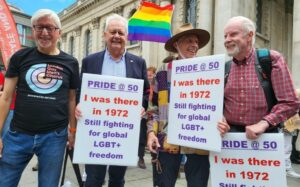
In 2017, the University held its first annual Wolfenden Lecture, funded by the Heritage Lottery Fund. Today, the Wolfenden Lecture series continues, welcoming national and international voices from the LGBTQIA+ community. It was most recently hosted by Reading alumnus Martin Kaufman, a prominent figure in Reading’s gay activist community during the 1970s.
Read more about Martin Kaufman’s story
![Black and white photograph of Baron Wolfenden, Vice-Chancellor, 1950-1963 with Sir Harry Pitt, Vice-Chancellor, 1964-1979 [Undated]](https://sites.reading.ac.uk/connected/wp-content/uploads/sites/43/2026/05/Connected-Body-770x480-14-300x187.png)
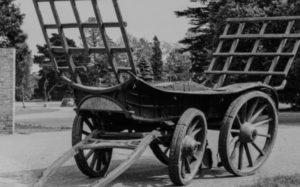
Did you know? In 1951, the Museum of English Rural Life (MERL) was established as part of the Department of Agriculture to document the rapidly changing countryside following the Second World War.
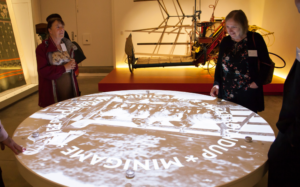
Today, MERL, as one of the University’s museums, continues to play a vital and vibrant role as an educational and community space, attracting visitors from around the world.
Did you know? The first academic building to be constructed on Whiteknights was The Faculty of Letters. The foundation stone was laid by Chancellor Viscount Templewood, on 18 May 1955 and the completed building was opened by Her Majesty the Queen, Elizabeth II, on 22 March 1957.
Since then, the building has gone by many names and nicknames, including Humanities and Social Sciences (HUMSS) Building and ‘the maze’.
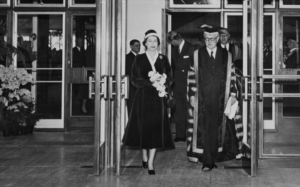
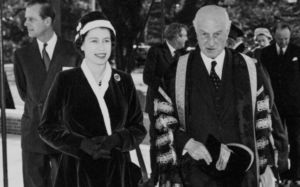
Today, it is the Edith Morley building, named after the first female professor in Britain and home to the Van Emden Lecture Theatre which hosts many of our popular public lectures.
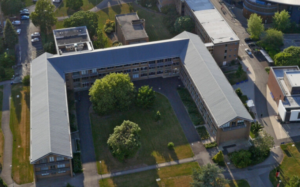
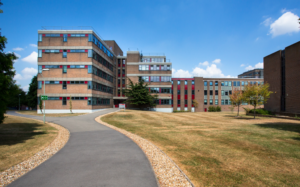
Did you know? The second building completed on Whiteknights was the J. J. Thomson Physics Laboratory, named after Sir Joseph John Thomson OM PRS, English physicist and Nobel laureate. It was opened by Sir George Thomson on 17 May 1960 and a Mathematics wing was added in 1965–66.
Today, the building is used for a variety of research, teaching and support services and remains a source of fond memories for many returning alumni.
Hear from our returning alumni
![Photographs of exterior views of the JJ Thomson Physical Laboratory, on Whiteknights Campus [Undated]](https://sites.reading.ac.uk/connected/wp-content/uploads/sites/43/2026/05/Connected-Body-770x480-20-300x187.png)
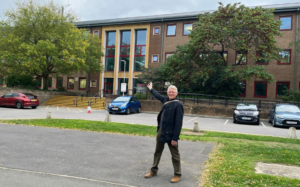
The Physics Laboratory was followed by the construction of the Sedimentology Research Laboratory (SRL), the Chemistry and Mathematics buildings, and the Library.
Did you know? As the building became increasingly important to the student experience at the University, it was decided that a new Library should be built on the Whiteknights campus to match the increasing demand. Planning for the Library began in 1957, with initial designs proposed in 1958. Construction started in December 1960, and the building was completed in 1963. It was officially opened on 15 May 1964 by the Chancellor Rt. Hon. Lord Bridges.
Today, the Library has seen its biggest ever refurbishment with a huge £40 million investment – creating an innovative learning environment and an integral part of the student experience. Completed at the end of 2019, the Library has now been transformed, with its impressive glass window exterior and contemporary facilities, whilst retaining its location in the centre of our campus.
![Photographs of exterior views of the Library on Whiteknights campus [Undated]](https://sites.reading.ac.uk/connected/wp-content/uploads/sites/43/2026/05/Connected-Body-770x480-21-300x187.png)
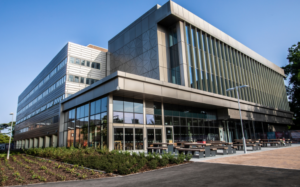
Did you know? In 1960, the University established its Special Collections archive, bringing together rare and valuable collections for research and teaching.
Today, the University is the custodian of literary and culturally important archives, including the world’s largest Samuel Beckett collection, the archives of publisher Mills & Boon, the Hogarth Press archives of Virginia and Leonard Woolfs, and a collection of letters and personal items belonging to James Joyce.
Did you know? In 1965, the University merged with the National College of Food Technology creating the Department of Food and Nutritional Sciences. Today, the department is one of the world’s leading centres for the study of food, nutrition, and health.
Did you know? In 1965,the Department of Meteorology was established.
Today, the department is at the forefront of climate science. Six lead authors of the most recent Intergovernmental Panel on Climate Change (IPCC) assessment of climate science are from Reading, and the department is leading the way in understanding and tackling the world’s environmental challenges.
Alumni memories
It’s not just our campus that holds these stories. We also heard from alumni whose own University highlights span the years 1944-1966 – moments of friendship, love, discovery, and lifelong connection.
David Loveday shared:
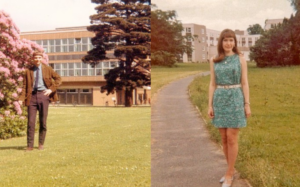
“In 1966 I was in my second year studying a General Honours Degree [Physics, Chemistry, Maths] when, on 19 November, I asked a first-year Mathematics student, Maureen Rendall, for a dance at the Saturday night Great Hall Graham Bond Organisation dance.
Three years later, we were married – and this year we will celebrate 60 years since our fateful meeting.”
For 1964 physics graduate, Penny Yates-Mercer, it was a time of change – both on campus and in everyday life. She shared: “I remember walking and cycling up to Whiteknights Park at a time when much of it was green fields, with just a few buildings – including the JJ Thomson Physical Laboratory. We watched the Sedimentology Building next door being built, and other buildings gradually rising up and coming into use around us, including the Library.
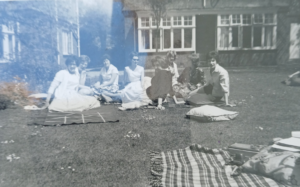
“My fondest memories are of St Andrew’s Hall where I was fortunate enough to spend all three years. I think of the summer times sitting on blankets on the grass in the back garden, listening to the Derby race on the radio in the sunshine.
“We should probably have been revising for our exams, but it was more fun enjoying ourselves, relaxing and sharing time with our friends.”
For many, the connections made at Reading have lasted a lifetime. For over a decade David Hopkins and Julian Holderness, along with their wives Liz and Rosie, have met each year in different parts of England to walk, talk and reminisce.
Julian reflected: “A lot of our conversations are spent reminiscing about our wonderful experiences at Reading in the early 1960s, where we were fortunate to live in Wantage – a very happy hall. We also enjoy putting the world to rights and talking of our wonderful children and grandchildren.
“It was a wonderful experience at Reading, which in so many ways helped form my view and understanding of the wider world. Wantage was an outstanding hall, where I made close friendships – some that have lasted since leaving in 1964.
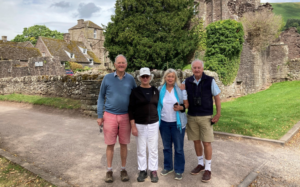
“Whiteknights was expanding rapidly during my time at Reading, as student numbers were growing and the Agriculture degree was highly regarded worldwide – as it still is today. I still love visiting Reading. The town and the University have grown significantly, but my fondness for them remains as strong as ever.
“Reading certainly helped me make friends for life.”
Share your story
Do you have an achievement, interesting story, or memory that you’d like to share with us? If so, then we’d love to hear from you at alumni@reading.ac.uk.
The University also invites you to reflect on Reading’s journey so far through its Centenary Wall of Wishes – a chance to share your message and celebrate this momentous year. You can submit your message via the Centenary Wall of Wishes form.
And, if you would like to revisit Whiteknights Campus and connect with fellow graduates, join us this May for our Centenary Community Festival weekend – the perfect opportunity to reconnect with old friends, make new connections, and celebrate your shared Reading experience.