
By: Anjali Chandar, Charlie Waller Institute (CWI), School of Psychology and Clinical Language Sciences (SPCLS), a.m.chandar@reading.ac.uk

Overview
Creating a cross-programme roleplay video library for diverse learners in clinical skills training.
Context
Size of the cohort: 21-50
The School, Directorate, or Function: School of Psychology & Clinical Language Sciences
The Programme of study: Postgraduate taught
Applies to the following aspects of the student experience:
- teaching materials
- other: OSCA and self-study
Context and implementation
The Charlie Waller Institute (CWI) is a vocational department within the School of Psychology and Clinical Language Sciences, that trains mental health practitioners delivering CBT or CBT informed interventions. Students across several CWI programmes consistently shared (or demonstrated via their assignments) that they needed more support in developing core clinical skills. Some of our trainees have additional needs such as autism and/or anxiety and
found that they wanted additional time to watch and process video demonstrations of the skills they needed to use with their real life clients.
To address this feedback, I led the creation of an online Roleplay Video Library, bringing together 57 short demonstration videos of essential CBT skills. These were either created collaboratively with staff or curated from existing recordings, and were typically 5-10 minutes long. I considered several inclusivity needs during development:
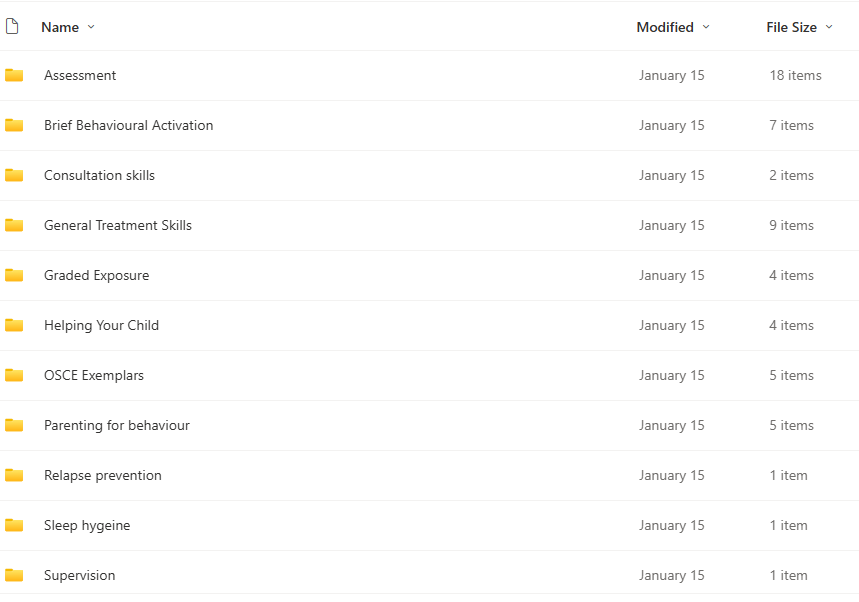
- Accessibility: videos are short, chunked, labelled, and easy to navigate; and all videos are hosted in a central, predictable location accessed via Blackboard (and stored on Sharepoint) (see Figure 2).
- Neurodiversity: the videos enable repetition, pausing, slower viewing, and reduced cognitive load, which may support our neurodivergent learners.
- Confidence and anxiety: students who struggle with performance anxiety can learn skills privately and repeatedly before OSCE exams and real life sessions with clients.
- Consistency: every trainee, across programmes and tutors, now sees the same core modelling, ensuring skills training is consistent and accurate.
- Teaching aid: lecturers have embedded the videos into teaching, often sharing a video in teaching before students are asked to roleplay with their peers.
I implemented the project by sourcing past videos that might be suitable to include, coordinating contributions from staff to create roleplays, created a lot of videos myself, created a shared structure to organise the videos on Sharepoint, and created a spreadsheet to detail the video, which folder it was saved in, and elements of best practice to look out for. I continue to request feedback from students and staff about any videos that might be missing, that we can then record and add to the library.
Impact
This work was important because students needed additional support with their clinical skills, and were asking for further support from university. We were also noticing that some of these skills were not being particularly well demonstrated in clinical video recordings of our students with their real life clients.
The Roleplay Video Library has provided an accessible, repeatable, self-paced way for trainees to learn and revise key CBT skills. Students report that the videos are a “great resource” that helps them feel more prepared for real life sessions, and supports their understanding of what competent skills look like. Neurodivergent trainees in particular, may value the ability to pause, rewind, and rewatch demonstrations at their own pace.
The library is now fully accessible across all programmes within CWI, and is used in class and independently by trainees. Crucially, other programmes have begun creating similar resources, indicating cultural and systemic impact beyond the initial project.
Lecturers consistently use the videos in teaching, leading to greater consistency and fairness across lecturers’ and what we expect to see from our trainees during in-class roleplays, or their clinical assignments. The project has also inspired other teams to create parallel resources, extending the reach of the impact.
Overall, the video library has improved confidence, inclusivity, accessibility, and cohesion in skills training.
Reflective practice
I initially created this resource to respond to student requests for more support with their clinical skills. However, in creating this library, and reflecting on its value, I can see now how it benefits a wide range of students, e.g. anxious or neurodivergent trainees. I also reflect on how tricky it can be to demonstrate skills in a timely way. For example, we might expect our students to complete an activity in 5 minutes, but when I have roleplayed it for the library, it’s taken me closer to 10 minutes. This therefore allows me and my team to reflect on the timings we expect of our
trainees, and we have now given additional time (an additional 5 minutes) in the OSCE assignment to ensure all material is covered. We have also removed the ability to auto fail if the roleplay is not finished within the time. It has therefore had a huge impact on designing fair assignments too.
Advice for colleagues
Make a start! Even a small library of videos of the most important skills could make a big difference to students who need repeated access. I would recommend the videos are easily labelled, with a spreadsheet that indicates what each video entails so students can choose which video is most helpful in advance, and stored in an obvious, accessible place. Seeking feedback is essential. Students can suggest the most helpful topics to be created as a priority. Share the load. See if other lecturers would be up for recording videos, particularly if they usually demo these skills in their teaching days already. Spreading the workload can mean that more videos are created in a shorter space of time. Please do reach out to me via email if you want any help in setting this up, or to let me know if my case study has encouraged you to create a similar resource library for your students!
About the author
Anjali Chandar is a Lecturer in the Charlie Waller Institute, within the School of Psychology and Clinical Language Sciences. She teaches across multiple vocational courses in Cognitive Behavioural Therapy, training the future mental health practitioners in the NHS and third sector. Her academic scholarship focusses on creating inclusive systems to support staff and student belonging, enabling them to thrive in academia and/or healthcare.