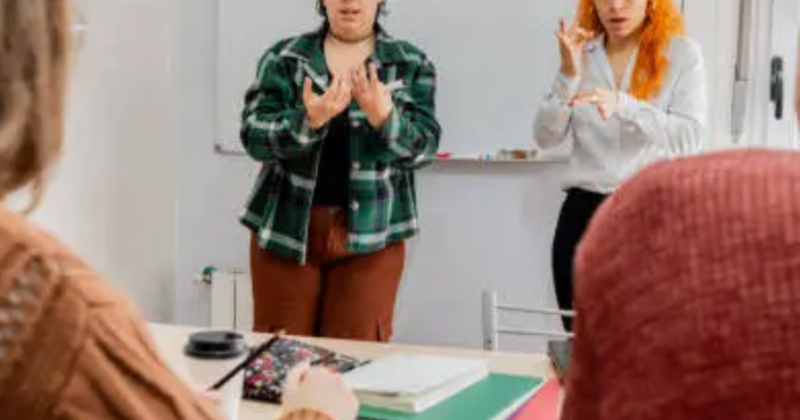
Exploring the Accessibility of Teaching for Deaf Students

Exploring the Accessibility of Teaching for Deaf Students

By: Emma-Jayne Conway, Adult PWP Programme Director, Lecturer in Clinical Psychology, Module Convenor, emma-jayne.conway@reading.ac.uk


Context

Size of the cohort: less than 20

The Programme of study: Postgraduate taught

Applies to the following aspects of the student experience:

  • in class test
  • coursework (essay)
  • coursework (research report)
  • seminar environment
  • teaching materials
  • lecture theatre
  • style of presentation (by staff)
  • style of presentation (by students)
  • group work
  • placement
  • field trip
  • exam (on campus)
  • exam (online)
  • other

Overview

Objectives

Context and implementation

This case study focuses on our experience of supporting two Deaf students enrolled on a clinical training programme (Psychological Wellbeing Practitioner [PWP] training). In this section, we outline key considerations and steps taken to ensure the equity of the training experience for Deaf trainees as far as was possible:

Getting initial support in place: for context, our students are typically employed in NHS Talking Therapies services and are recruited by services only a month or so prior to enrolling with us. This leaves little time for them to apply for the financial assistance (Disabled Student Allowance, or DSA) required for essential support during training, including notetakers and interpreters, and meant that for both students, a significant amount of time was spent by the team to ensure that this support was in place at the start of their training. As well as ensuring support for our students, it was also important for the team and other trainees to receive specialist guidance on working with Deaf people, and this was delivered prior to the start of our courses for admin and educator staff and at induction for students.

Supporting facilitators to support trainees: throughout the training year, it was important to use a small and consistent team of interpreters and notetakers, and to frequently check in with our Deaf trainees regarding their experience of this support. We also were also mindful of the jargon-based and potentially emotional nature of the training, and to this end ensured that all teaching slides and related resources were sent across to facilitators in good time to ensure they could get in touch with any questions. Going forwards, we would take additional steps to check in regularly with facilitators regarding the emotional impact that this work may have evoked.

Practical adaptations in teaching: to safeguard equity in teaching, we had to ensure that all video and audio resources were accessible (e.g. closed captions), and that online learning platforms were fit for purpose. This meant that during live online teaching on Blackboard Collaborate, interpreters and notetakers, along with our Deaf students, had to log into a simultaneous Zoom call to provide/access interpretation of the taught content. We also needed to think carefully about clinical skills training. Traditionally, this has relied on observing roleplays with students playing the role of patient and PWP. As our Deaf students delivered their clinical work in BSL, it was important to facilitate this in teaching, with BSL partners brought in wherever possible (we only had one deaf student in each cohort, so it was not possible for them to roleplay with each other).

Adaptations in assessments: to safeguard equity in assessment, it was important to consider the impact on timings of a BSL speaker having to role play with someone using English (the duration of these assessed role plays were doubled). For clinical treatment recordings delivered in BSL (that were then translated for our English speaking markers), we needed to be mindful of inaccuracies that may arise in translation, as well as differences in communication style across the hearing and Deaf communities. It was helpful to consult with Deaf clinicians when any issues arose around this.


Impact

The adaptations implemented had a positive impact on the learning experience and equity of access of our Deaf trainees. By ensuring that essential resources and training were in place from the start of the course, it helped to reduce stress and uncertainty for the students whilst also promoting a culture of awareness and sensitivity within the cohort.

The use of a consistent team of interpreters and notetakers provided a sense of continuity, which allowed trust to be built between the Deaf students and their support team. One of the interpreters commented that the sharing of teaching materials in advance was particularly useful, “The educators making sure that we received the slides and other resources before the teaching day made the single biggest difference to my ability to support the student.” This allowed interpreters time to clarify jargon-heavy or emotionally complex content in advance, thus improving the quality of interpretation.

To ensure equity in teaching and assessment, several adjustments were made to the learning environment and summative assignments including role-playing with role play partners in BSL during clinical skills and the educator team consulting with Deaf clinicians when marking treatment recordings. This proactive approach ensured that our trainees could fully participate in lecture discussions and activities and were not disadvantaged by having their assessments marked by non-BSL users.

Overall, it was commented that these adaptations reflected a positive, ‘can do’ attitude from the educators and admin team. The increased awareness for staff in working with Deaf students will have a lasting impact beyond these cohorts.


Reflective practice

What went well: Adjustments were made and the students successfully passed the course with their cohort. A key reason this worked well was due to the team communicating effectively with all stakeholders and working together to problem solve and troubleshoot. The team would regularly discuss this within the weekly team meetings to ensure actions were being met.

What could be improved: Due to the way our courses are funded, our student numbers can be confirmed very close to the start of the course. Therefore, provisions had to be organised with short notice. There were delays to accessing more immediate support like ad-hoc meetings, as it took time to book interpreters and left the student accessing immediate support via email. Furthermore, the preparation and adjustments made took a large amount of staff time which was not factored into the staff workload model.


Advice for colleagues

When making significant adaptations to a programme to promote inclusivity, it is helpful to think about the student’s journey sequentially.

Firstly, identify the initial steps needed to prepare the student requiring support, the other students on the course and the educator team before the course begins. This might include upskilling staff (e.g. additional training) and increasing awareness among students (e.g. open discussions), so all are better equipped to provide and create an inclusive environment.

Secondly, adopting a flexible approach to preplanned adaptions will allow you to continuously review whether the adaptions implemented are meaningful. Establishing regular opportunities for feedback is important, as well as using a variety of feedback methods (e.g. Padlet, module evaluations, academic tutorials).

Finally, it is crucial to reflect with students, staff and stakeholders on the adaptions implemented and the process of orchestrating the implementations, including the sustainability of making such adaptations. Having protected time to reflect can generate important discussions that inform future pedagogy. And lastly… remember to disseminate!


Creating a cross-programme roleplay video library for diverse learners in clinical skills training

Creating a cross-programme roleplay video library for diverse learners in clinical skills training


By: Anjali Chandar, School/function, a.m.chandar@reading.ac.uk

Size of the cohort: 21-50

The Programme of study: Postgraduate taught

Applies to the following aspects of the student experience:

  • in class test
  • coursework (essay)
  • coursework (research report)
  • seminar environment
  • teaching materials
  • lecture theatre
  • style of presentation (by staff)
  • style of presentation (by students)
  • group work
  • placement
  • field trip
  • exam (on campus)
  • exam (online)
  • other: OSCA and self-study

Context and implementation

he Charlie Waller Institute (CWI) is a vocational department within the School of Psychology and Clinical Language Sciences, that trains mental health
practitioners delivering CBT or CBT informed interventions. Students across several CWI programmes consistently shared (or demonstrated via their
assignments) that they needed more support in developing core clinical skills. Some of our trainees have additional needs such as autism and/or anxiety and
found that they wanted additional time to watch and process video demonstrations of the skills they needed to use with their real life clients.
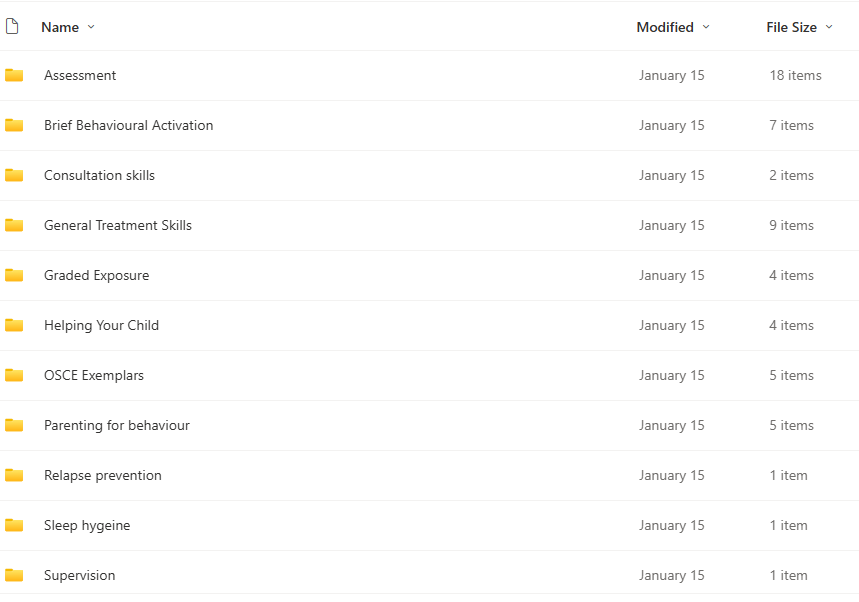
To address this feedback, I led the creation of an online Roleplay Video Library, bringing together 57 short demonstration videos of essential CBT skills. These
were either created collaboratively with staff or curated from existing recordings, and were typically 5-10 minutes long.
I considered several inclusivity needs during development:
• Accessibility: videos are short, chunked, labelled, and easy to navigate; and all videos are hosted in a central, predictable location accessed via Blackboard
(and stored on Sharepoint).
• Neurodiversity: the videos enable repetition, pausing, slower viewing, and reduced cognitive load, which may support our neurodivergent learners.
• Confidence and anxiety: students who struggle with performance anxiety can learn skills privately and repeatedly before OSCE exams and real life sessions
with clients.
• Consistency: every trainee, across programmes and tutors, now sees the same core modelling, ensuring skills training is consistent and accurate.
• Teaching aid: lecturers have embedded the videos into teaching, often sharing a video in teaching before students are asked to roleplay with their peers.
I implemented the project by sourcing past videos that might be suitable to include, coordinating contributions from staff to create roleplays, created a lot of
videos myself, created a shared structure to organise the videos on Sharepoint, and created a spreadsheet to detail the video, which folder it was saved in,
and elements of best practice to look out for. I continue to request feedback from students and staff about any videos that might be missing, that we can
then record and add to the library.
The library is now fully accessible across all programmes within CWI, and is used in class and independently by trainees. Crucially, other programmes have
begun creating similar resources, indicating cultural and systemic impact beyond the initial project.


Impact

This work was important because students needed additional support with their clinical skills, and were asking for further support from university. We were
also noticing that some of these skills were not being particularly well demonstrated in clinical video recordings of our students with their real life clients.
The Roleplay Video Library has provided an accessible, repeatable, self-paced way for trainees to learn and revise key CBT skills. Students report that the
videos are a “great resource” that helps them feel more prepared for real life sessions, and supports their understanding of what competent skills look like.
Neurodivergent trainees in particular, may value the ability to pause, rewind, and rewatch demonstrations at their own pace.
Lecturers consistently use the videos in teaching, leading to greater consistency and fairness across lecturers’ and what we expect to see from our trainees
during in-class roleplays, or their clinical assignments. The project has also inspired other teams to create parallel resources, extending the reach of the
impact.
Overall, the video library has improved confidence, inclusivity, accessibility, and cohesion in skills training.


Reflective practice

I initially created this resource to respond to student requests for more support with their clinical skills. However, in creating this library, and reflecting on its
value, I can see now how it benefits a wide range of students, e.g. anxious or neurodivergent trainees.
I also reflect on how tricky it can be to demonstrate skills in a timely way. For example, we might expect our students to complete an activity in 5 minutes, but
when I have roleplayed it for the library, it’s taken me closer to 10 minutes. This therefore allows me and my team to reflect on the timings we expect of our
trainees, and we have now given additional time (an additional 5 minutes) in the OSCE assignment to ensure all material is covered. We have also removed
the ability to auto fail if the roleplay is not finished within the time. It has therefore had a huge impact on designing fair assignments too.


Advice for colleagues

Make a start! Even a small library of videos of the most important skills could make a big difference to students who need repeated access. I would recommend the videos are easily labelled, with a spreadsheet that indicates what each video entails so students can choose which video is most helpful in advance, and stored in an obvious, accessible place. Seeking feedback is essential. Students can suggest the most helpful topics to be created as a priority. Share the load. See if other lecturers would be up for recording videos, particularly if they usually demo these skills in their teaching days already. Spreading the workload can mean that more videos are created in a shorter space of time. Please do reach out to me via email if you want any help in setting this up, or to let me know if my case study has encouraged you to create a similar resource library for your students!

Enhancing Students’ Sense of Belonging in a Global University

Enhancing Students’ Sense of Belonging in a Global University


By: Professor Elisabeth Wilding & Professor Daguo Li, International Study and Language Institute (ISLI), e.a.wilding@reading.ac.uk; d.li@reading.ac.uk


Excerpt

“This case study reports on a one-year initiative to develop collaborative exchange activities for undergraduates involved in transnational (TNE) programmes offered at both the NUIST Reading Academy (Nanjing, China) and the University of Reading”.

Overview

By working with students, we developed both staff-led and student-led activities to create opportunities for inter-campus interaction. As a result, there was an increased level of collaboration between students in China and the UK, through online conversation cafes, an intercultural communication seminar, and two live broadcasts.


Objectives

· To develop collaborative exchange activities for students involved in programmes offered at both the NUIST Reading Academy and in the UK.

· To build sustained interaction that would enhance the students’ feeling of belonging within our global university.

· To have a positive effect on the overall student experience.


Context

The project was designed in response to concerns voiced by students at the NUIST Reading Academy (China), who reported how they felt a lack of interaction or connection with the UK campus. We aimed to engage students on the two campuses in shared activities that could enhance experiences for everyone.


Implementation

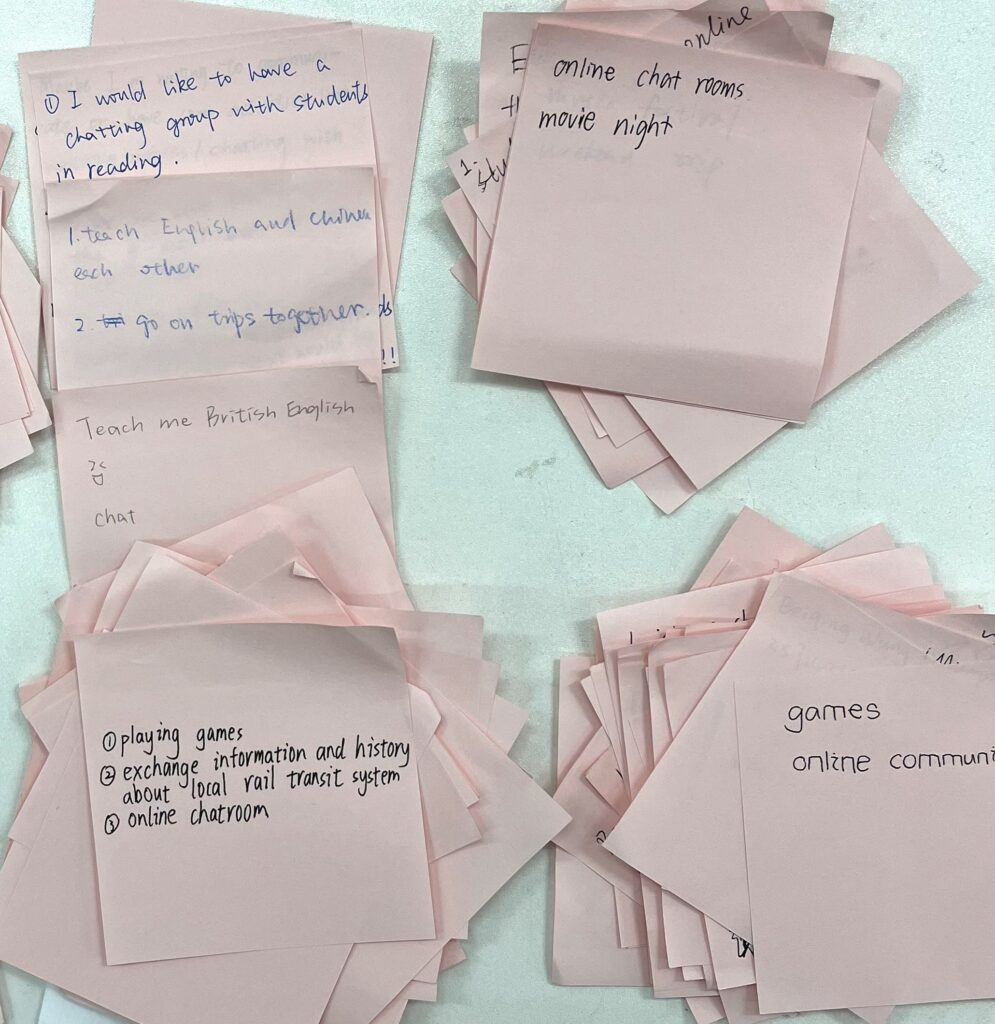
1. To launch the project, we collected input from Nanjing-based students on their ideas for collaborative activities.

2. We held a series of meetings with our student partners, including an induction, as well as brainstorming and planning sessions.

3. We encouraged students to tak

e the initiative to suggest and lead activities.

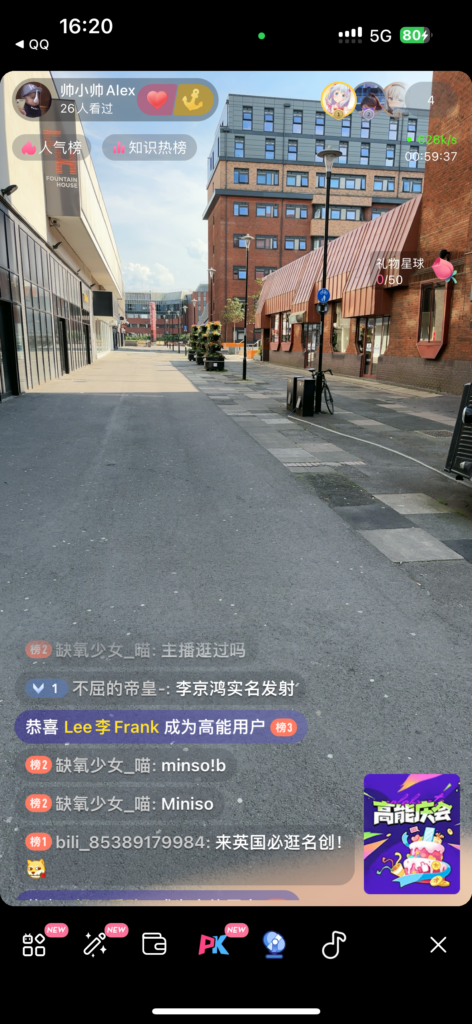
o Two student partners worked together to successfully organise broadcasts from the UK to enable Nanjing-based students to sample “live” the UoR campus life and town life.

o Other partners attempted to engage RUSU student societies in collaborative activities (though with less success).

4. Staff-led activities were run concurrently, including an intercultural communication workshop with Nanjing- and Whiteknights-based students during a flying faculty visit to the Academy. We also arranged for Academy students to have access to the Online English Conversation Cafes at UoR, which attracted a number of enthusiastic participants from China. Both of these activities will be sustained beyond the project end.

5. Student feedback was collected at each stage.


Impact

The Project has achieved its objectives overall. , There was an increased level of interaction between students in China and the UK. Here is one example: The Academy students now have access to the online English Conversation Cafes that take place about every two weeks during term time. We have records that students signed up to the Cafes, and a number gave positive feedback to the organiser. Both students in Nanjing and Reading benefitted from the online intercultural exchange, so we will continue in 2024/25.

We have also learned valuable lessons from this experience. Challenges included engaging student partners on the student-led activities. It was partly due to assessments and crunch points in student life.


Reflections

· For student-led activities, they were more successful if student partners had experience of organising similar activities already.

· Initial staff encouragement, support and monitoring for student-led activities were important.

· Integrating staff-led activities proved to be successful and sustainable.

· Long-term planning would be needed if activities are to involve student bodies such as the Students’ Union or its societies. The length of the Project meant that it was impossible to do long-term planning.


Follow up

Online English conversation club, Intercultural Communication workshop and increasing student exposure to UoR presence in Nanjing have continued even after the project.