
By: Dr Laura Girling, School of Agriculture, Policy and Development laura.girling@reading.ac.uk

Overview
“Eco-CSI” is an inquiry-based, active learning session; and is the first of three RAFT (Resilience, Acceptance, Friendship & Teamwork) workshops.
Students collaborated in their Academic Tutor groups to practice skills in analyse and evaluation of the evidence and interview stakeholders, also whilst developing connections with their peers, building confidence with staff, and creating a sense of belonging.
Objectives
Aim of the Eco-CSI session was to:
- Build connections and foster collaboration among students and teaching staff of the EMS Programme (Social interactions)
- Explore potential anthropogenic factors contributing to species decline (discipline knowledge)
- Practice critical thinking, evidence-based reasoning, problem solving and communication skills within a local sustainability context (skill development)
The wider RAFT related aim to build a sense of belonging and support student transition to university underpinned this session.
Context
Students identify making friends as a major concern when starting university. This session, embedded within our RAFT programme to support student transition into university, was designed to address this by aligning with the four elements of Allen et al.’s (2022) Belonging Framework. It provided a low-stakes opportunity for students to collaborate with both peers and staff, helping to build connections, confidence and communication skills.
The session integrated academic skill development including teamwork, problem solving and critical thinking, which align with the modules learning objectives, and were embedded within a subject-specific theme.
Implementation
The activity was delivered in week 2 as part of the AD1KSE module with EMS teaching staff in attendance. Students worked in their academic tutor groups (~5 individuals) and were tasked with investigating “where have all the hedgehogs gone?”, and to suggest a management plan to support the campus hedgehog population.
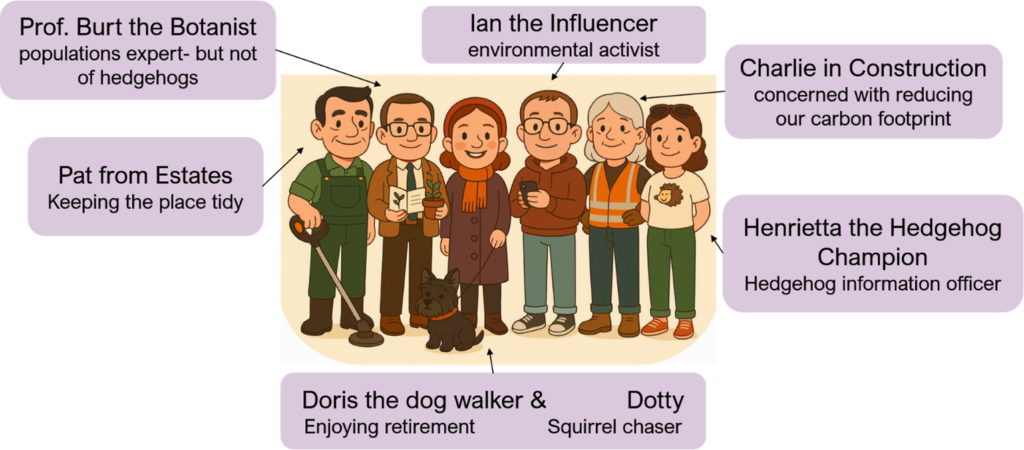
Following the initial briefing on the scenario, groups were distributed across three rooms to enable students to provide space for discussion. Each group received a pack of “evidence” containing a mixture of real and scenario-generated documents of varying quality and relevance. The teaching staff role-played “campus stakeholders” (figure 1) and were interviewed by each group, presenting their opinions and knowledge about the issue. Students were required to critically evaluate the reliability and value in understanding the issue of both the stakeholder interactions and paper evidence.
Groups reflected upon information, formed a response, and identified strategies to support the University’s hedgehog populations, before feeding back their ideas to the class and tutors. Formative feedback was verbally provided, and a winning group was identified based on the overall quality of their analysis and proposed management plan.
Impact
The session gave student the opportunity to experience all four elements that feature within Allen’s et al. (2022) Framework for Belonging and aligned with the objectives, particularly around creating meaningful social interactions and building competencies.
A Likert-scale evaluation (1= not at all; 5= completely agree) was conducted following the session. The highest scoring outcomes were increased “comfort” (4.6) and “confidence” (4.5) of speaking with teaching staff, suggesting reduced perceived barriers between students and staff. The lowest scoring outcomes, although still overall positive, related to speaking to other students (3.4) and feeling a sense of belonging (3.9). This suggests students may find peer interactions more challenging than interactions with staff at this stage of their university transition and that a single intervention is unlikely to be sufficient in establishing a strong sense of belonging.
Although not quantifiable, there appears to be a greater sense of openness between students and staff, with more students flagging concerns or absences of others within the module to the module convener than in previous years.
Reflections
The success of this session was hugely dependent on the strong buy-in of teaching staff; fully embracing in the role-play and keeping the session interesting and fun. The alignment with Allen et al.’s (2022) Framework for Belonging ensured the activity utilised competencies to promote collaboration and provided opportunities and motivations to engage by being authentic, discipline relevant and involve active learning, whilst also being low-risk, reducing concerns around performance. The competitive element further enhanced motivation and engagement, fostering a sense of belonging within their tutor groups.
This session was resource heavy, requiring six members of staff and significant preparation. Given the difficulties in measuring the long-term impacts, some staff might question if the outcomes justified the costs. Opportunities to streamline the session may include the “stakeholders” attending for only 1 hour- and requesting a location nearer to staff offices. In addition, providing written feedback – particularly highlighting academic skills involved – could support students’ reflecting on the session in the future.
Follow up
This session is part of the RAFT intervention and the full programme evaluation scheduled for August 2026. Subject to positive evidence and staff-by in, we intend to run similar activities in future years. Key areas to develop include identifying ways to minimise staff resources required, and ensure formative feedback is captured effectively so it can be used as feedforward.
References
- Allen, K., Kern, M. L., Rozek, C. S., McInereney, D., Slavich, G. M. (2022). Belonging: A review of conceptual issues, an integrative framework, and directions for future research. Australian Journal of Psychology, 73(1), 87-102. https://doi.org/10.1080/00049530.2021.1883409