Eco-CSI: “Where have all the hedgehogs gone?”

Eco-CSI: “Where have all the hedgehogs gone?”


By: Dr Laura Girling, School of Agriculture, Policy and Development laura.girling@reading.ac.uk

Photo by Alexas_Fotos on Unsplash

Overview

“Eco-CSI” is an inquiry-based, active learning session; and is the first of three RAFT (Resilience, Acceptance, Friendship & Teamwork) workshops.

Students collaborated in their Academic Tutor groups to practice skills in analyse and evaluation of the evidence and interview stakeholders, also whilst developing connections with their peers, building confidence with staff, and creating a sense of belonging.

Objectives

Aim of the Eco-CSI session was to:

  • Build connections and foster collaboration among students and teaching staff of the EMS Programme (Social interactions)
  • Explore potential anthropogenic factors contributing to species decline (discipline knowledge)
  • Practice critical thinking, evidence-based reasoning, problem solving and communication skills within a local sustainability context (skill development)

The wider RAFT related aim to build a sense of belonging and support student transition to university underpinned this session.

Context

Students identify making friends as a major concern when starting university. This session, embedded within our RAFT programme to support student transition into university, was designed to address this by aligning with the four elements of Allen et al.’s (2022) Belonging Framework. It provided a low-stakes opportunity for students to collaborate with both peers and staff, helping to build connections, confidence and communication skills.

The session integrated academic skill development including teamwork, problem solving and critical thinking, which align with the modules learning objectives, and were embedded within a subject-specific theme.

Implementation

The activity was delivered in week 2 as part of the AD1KSE module with EMS teaching staff in attendance. Students worked in their academic tutor groups (~5 individuals) and were tasked with investigating “where have all the hedgehogs gone?”, and to suggest a management plan to support the campus hedgehog population.

Following the initial briefing on the scenario, groups were distributed across three rooms to enable students to provide space for discussion. Each group received a pack of “evidence” containing a mixture of real and scenario-generated documents of varying quality and relevance. The teaching staff role-played “campus stakeholders” (figure 1) and were interviewed by each group, presenting their opinions and knowledge about the issue. Students were required to critically evaluate the reliability and value in understanding the issue of both the stakeholder interactions and paper evidence.
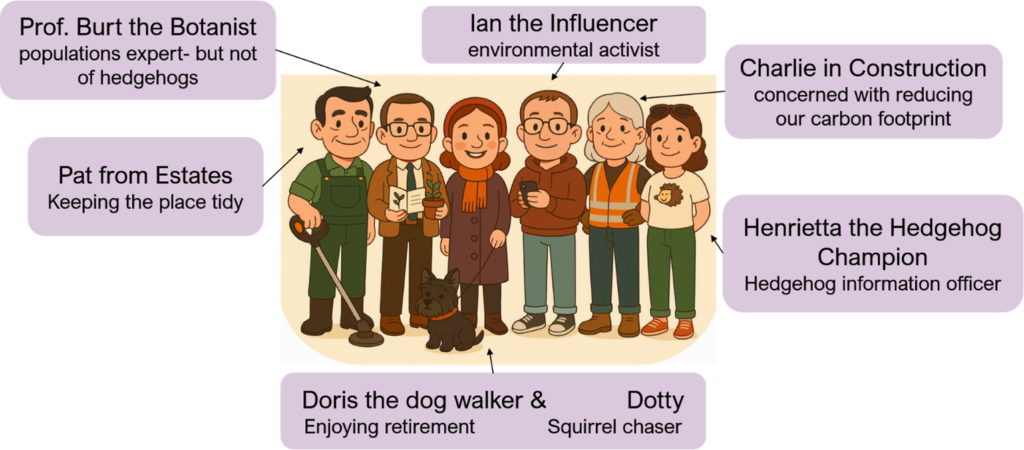
Illustrated stakeholder map showing six cartoon characters and a small dog, each identified by a labelled callout box. From left to right: Pat from Estates, described as “Keeping the place tidy,” stands with gardening equipment; Prof. Burt the Botanist is described as a “populations expert – but not of hedgehogs”; a central figure is labelled Ian the Influencer, an “environmental activist”; Charlie in Construction is described as “concerned with reducing our carbon footprint”; and Henrietta the Hedgehog Champion is the “Hedgehog information officer.” At the bottom, a dog is labelled Dotty, “Squirrel chaser,” and the accompanying owner is labelled Doris the dog walker, “Enjoying retirement.” Arrows link each label to the relevant character. The diagram illustrates a diverse group of stakeholders with different interests and expertise related to a hedgehog or environmental project.
Figure 1. University of Reading Key campus stakeholders. Each character contributed evidence towards the Eco-CSI – “Where have all the Hedgehogs gone?” workshop and were role-played by a member of the SLM teaching team. Image generated by Microsoft CoPilot.

Groups reflected upon information, formed a response, and identified strategies to support the University’s hedgehog populations, before feeding back their ideas to the class and tutors. Formative feedback was verbally provided, and a winning group was identified based on the overall quality of their analysis and proposed management plan.

Impact

The session gave student the opportunity to experience all four elements that feature within Allen’s et al. (2022) Framework for Belonging and aligned with the objectives, particularly around creating meaningful social interactions and building competencies.

A Likert-scale evaluation (1= not at all; 5= completely agree) was conducted following the session.  The highest scoring outcomes were increased “comfort” (4.6) and “confidence” (4.5) of speaking with teaching staff, suggesting reduced perceived barriers between students and staff. The lowest scoring outcomes, although still overall positive, related to speaking to other students (3.4) and feeling a sense of belonging (3.9). This suggests students may find peer interactions more challenging than interactions with staff at this stage of their university transition and that a single intervention is unlikely to be sufficient in establishing a strong sense of belonging.

Although not quantifiable, there appears to be a greater sense of openness between students and staff, with more students flagging concerns or absences of others within the module to the module convener than in previous years.

Reflections

The success of this session was hugely dependent on the strong buy-in of teaching staff; fully embracing in the role-play and keeping the session interesting and fun. The alignment with Allen et al.’s (2022) Framework for Belonging ensured the activity utilised competencies to promote collaboration and provided opportunities and motivations to engage by being authentic, discipline relevant and involve active learning, whilst also being low-risk, reducing concerns around performance. The competitive element further enhanced motivation and engagement, fostering a sense of belonging within their tutor groups.

This session was resource heavy, requiring six members of staff and significant preparation. Given the difficulties in measuring the long-term impacts, some staff might question if the outcomes justified the costs. Opportunities to streamline the session may include the “stakeholders” attending for only 1 hour- and requesting a location nearer to staff offices. In addition, providing written feedback – particularly  highlighting academic skills involved – could support students’ reflecting on the session in the future.

Follow up

This session is part of the RAFT intervention and the full programme evaluation scheduled for August 2026. Subject to positive evidence and staff-by in, we intend to run similar activities in future years. Key areas to develop include identifying ways to minimise staff resources required, and ensure formative feedback is captured effectively so it can be used as feedforward.

References

  • Allen, K., Kern, M. L., Rozek, C. S., McInereney, D., Slavich, G. M. (2022). Belonging: A review of conceptual issues, an integrative framework, and directions for future research. Australian Journal of Psychology, 73(1), 87-102. https://doi.org/10.1080/00049530.2021.1883409
 

Embedding entrepreneurship and technology literacy in the student curriculum: A case study of a module for real estate students


By: Dr Matteo Borghi, Henley Business School, m.borghi4@henley.ac.uk
Decorative image
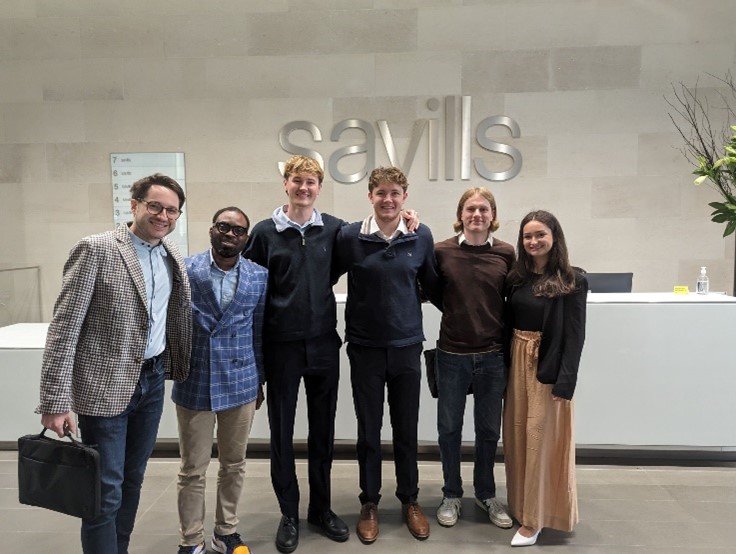
Exclusive study visit to Savills headquarters in London by students, one of the practical employability outcomes of the curriculum and assessment redesign © Matteo Borghi

Overview

The Managing Change in the Real Estate Sector module was redesigned to embed entrepreneurship (the ability to identify and seize business opportunities) and technology literacy, aiming to bridge academic learning with real-world industry demands. The initiative significantly improved student engagement, understanding of PropTech (technology-driven innovation in Real Estate) trends and practical application of entrepreneurial skills, as reflected in enhanced student satisfaction and successful project outcomes.

Objectives

Foster students’ entrepreneurship skills (such as opportunity recognition, innovation, and problem-solving) and technology literacy, particularly in the context of PropTech (short for Property Technologies).

  • Encourage creative problem-solving and the development of innovative business ideas.
  • Enhance students’ practical understanding of industry trends through direct engagement with experts.
  • Improve student confidence and readiness for entrepreneurial careers in real estate through authentic assessments.

Context

The Managing Change in the Real Estate Sector module was developed to address the evolving needs of the real estate industry, particularly the integration of technology literacy (the ability to effectively use and understand modern technologies) and entrepreneurial skills. It was introduced in response to industry demands for graduates proficient in PropTech (technology-driven innovation in Real Estate) and capable of innovative thinking. In this context, entrepreneurial skills refer to the ability to identify opportunities, adapt to changing circumstances, and implement creative solutions within the real estate sector. The module, which carries 20 credits, is compulsory for approximately 120 Level 5 students each year.

Implementation

To implement the module, several key steps were taken:

  1. Module Design and Collaboration: The curriculum was developed in collaboration with internal teams, including the Henley career services and the Henley Centre for Entrepreneurship, to ensure alignment with industry needs and academic goals.
  2. Guest Lectures and Forums: External experts were invited to provide insights into PropTech and entrepreneurship, culminating in the Global Henley PropTech Forum (GHPTF) where students engaged with industry leaders. In the GHPTF, we included a general Q&A and an interactive co-creation session where students collaborated with industry leaders to refine the business ideas they had developed with the seminar leader during the first six weeks of the module.
  3. Dragons’ Den Assessment: A competitive pitching event was organised, where student teams presented their business ideas to a panel of judges, simulating a real-world entrepreneurial experience. This event mirrored the format of the famous British television show Dragons’ Den, where aspiring entrepreneurs pitch their business ideas to a panel of investors (Dragons) seeking promising ventures. To prepare for the Dragons’ Den assessment, students engaged in weekly seminar sessions, mock presentations with cross-fertilisation between teams, and a dedicated ‘Pitching to Sell’ workshop.
  4. Continuous Feedback and Adjustment: Throughout the module, student feedback was actively solicited and used to make real-time adjustments, enhancing the learning experience and addressing concerns.
  5. Support Structures: The module included mentoring and support from faculty, promoting an environment conducive to innovative thinking and teamwork.
Decorative image
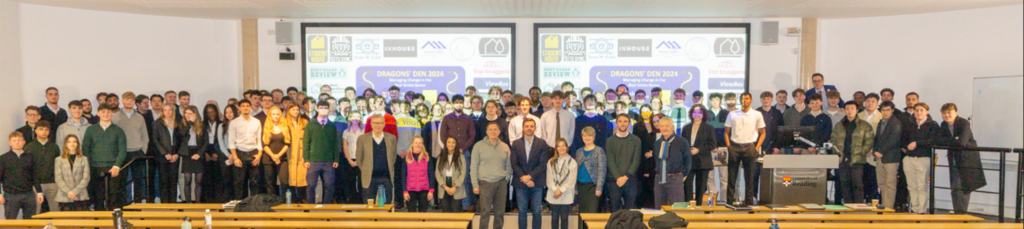
Dragons’ Den 2024 © Erno Frak

Impact

The module successfully achieved its objectives, as reflected in students’ positive feedback on experiential learning methods (4.3/5). Integrating entrepreneurship and technology literacy greatly enhanced students’ understanding of real estate and PropTech. This resulted in improved business propositions and heightened student engagement, praised by both internal and external contributors. An unexpected outcome was the module’s selection as the main compulsory team project for future students. Additionally, a student venture developed during the module was shortlisted in the European PropTech competition, demonstrating the initiative’s success in fostering critical real-world skills such as problem-solving, creative thinking, digital proficiency, and the ability to navigate the intersection of technology and business.

Reflections

The success of the module stemmed from its integration of real-world experiences with academic learning, enhanced by effective collaboration with industry experts and external events. Key elements included the Global Henley PropTech Forum and Dragons’ Den assessments, which provided students with invaluable exposure to real-world scenarios and feedback. The responsiveness to mid-module feedback and adaptation of content and support mechanisms significantly contributed to student satisfaction and engagement.

Decorative image
Global Henley PropTech Forum 2023 © Matteo Borghi

However, some challenges remained. Coordination issues with guest speakers and unexpected withdrawals from the Dragons’ Den highlighted the need for more robust contingency planning. Additionally, while student feedback on individualised guidance was addressed, further improvement in personal mentorship could enhance the learning experience. Future iterations could benefit from more structured self-assessment and additional real-world case studies to deepen students’ understanding and application of entrepreneurial concepts. Overall, the module demonstrated a strong capacity to evolve and adapt, ensuring its continued relevance and effectiveness.

Follow up

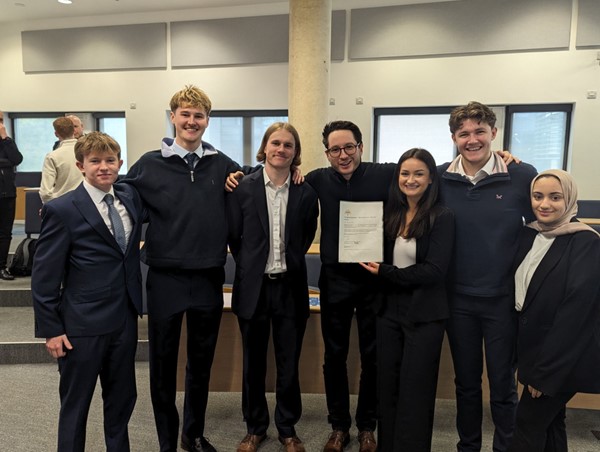
Since the module’s implementation, it has garnered additional industry support. Savills, a prominent global real estate services provider, has endorsed a revised version of the Dragons’ Den, featuring a grand final and a study visit for the winning team (see title image above). Additionally, an exclusive internship opportunity was offered by one of the Dragons. The 2024 winning team, Senspore, also achieved significant success by securing £3,000 for the best commercialisation idea for China at Henley Business School’s IDEAFEST student business idea competition.

Decorative image
Senspore winning the best commercialisation idea for China at Henley Business School’s IDEAFEST student business idea competition © Matteo Borghi

Links

The published article can be downloaded for free from Innovations in Education and Teaching International.

Designing an authentic assessment tailored specifically for Part 4 students

Designing an authentic assessment tailored specifically for Part 4 students


By: Dr Julia Abery, Department of Mathematics and Statistics, j.abery@reading.ac.uk

Four people watching a Macbook

Photo by Mimi Thian on Unsplash

Overview

I designed a tailored applied statistics assignment for a UoR Part 4 Department of Mathematics and Statistics module (module code ST4MVA) which successfully met two distinct objectives. Firstly, the assignment tested advanced, specific masters-level skills, as outlined in the QAA framework. Secondly, the assignment incorporated the critical elements of authentic assessment as recommended by Ashford-Rowe et al. (2014).

Objectives

In designing the assessment, the objectives were as follows:

  • To test masters-level skills described in the QAA L7 descriptor and to conform to departmental guidelines for L7 assessment.
  • To align with the ALOs (assessable learning outcomes) of the Part 4 applied statistics module ST4MVA.
  • To incorporate the critical elements of an authentic assessment, aiming to improve student engagement and develop employability skills.

Context

I produced a Part 4 assessment in multivariate methods which tests specific, advanced level 7 skills including systematic subject knowledge, evaluation, analysis, creation and independent research, to align with our department’s aims for assessment at this level.

Following discussion with colleagues and students, I became persuaded that an authentic assessment could increase value and meaning to the student. This meant basing the assessment on engaging ‘real-world’ scenarios, and aiming to incorporate employability skills and to promote deeper learning approaches.

Implementation

I consulted ST4MVA ALOs and departmental guidelines for Part 4 assessment, and decided on a data analysis assignment requiring selection and implementation of a range of multivariate methods in the statistical computing package R, some of which are researched independently. I took direction from the QAA level 7 descriptor; ‘to deal with complex issues both systematically and creatively … communicate their conclusions clearly to specialist and non-specialist audiences; demonstrate self-direction and originality in tackling and solving problems, and act autonomously in planning and implementing tasks at a professional or equivalent level.’ I designed an open ended task, so students could be creative and direct their own work. I requested two written reports, for specialist and non-specialist audiences.

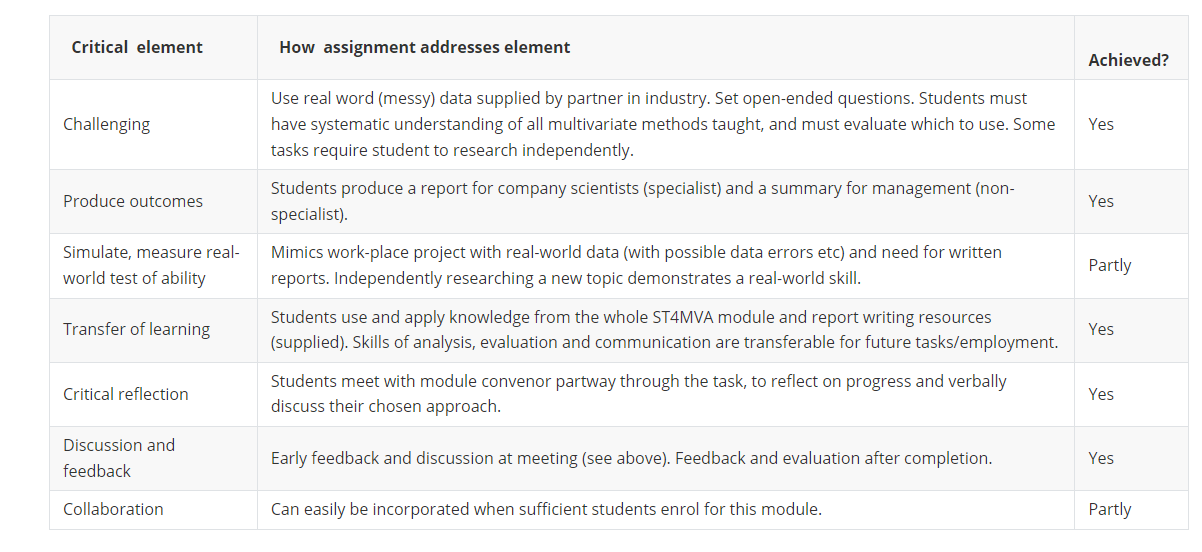
Having reviewed various articles, I elected to use a simplified version of Ashford-Rowe et al.’s (2014) list of critical elements of authentic assessment. The table below shows how the assignment addresses these elements.

Table with three columns - see file download for accessible version

Select here to download an accessible version of this table.

Impact

Feedback from internal and external examiners and other colleagues suggests the assignment successfully captures features of an authentic assessment and allows students to demonstrate higher level abilities and employability skills.  Some colleagues thought a similar approach might be used elsewhere in our programmes. Writing an assignment with close alignment to the principles of authentic assessment was instructive and will undoubtedly influence the way I approach assessment in other modules and at other levels.

Students reported that the tasks were genuinely useful ones to practise and master, and tested higher level skills such as evaluation, creativity and analysis. The assignment was felt to be challenging and at least moderately engaging and interesting. One student commented ‘being able to apply the techniques we had learnt in lectures onto “real world data” made it very applicable to a real-world scenario[s].’

Reflections

At least three features helped to ensure success: Firstly, obtaining data from an industry partner, and working on the project with them, helped to maintain a real-world focus and ensured employability skills were assessed. Secondly, detailed scrutiny of the assignment by experienced internal and external examiners resulted in making some changes and improvements which led to a better and more challenging assignment. This highlights the benefits of collaborating with colleagues and other academics when developing authentic assessment, and being open to constructive criticism. Thirdly, consulting the literature and identifying a checklist ensured that I had clear objectives and maintained a wide perspective on different aspects of authentic assessment.

On reflection, a fuller understanding of authentic assessment may be achieved by consulting local employers, identifying skills they look for when they recruit and checking whether assessments align well with these. More feedback from students would be beneficial, clarifying the extent to which claims in the literature of enhanced learning, increased engagement and motivation play out in students’ experience.

The assessment has now been released, completed and marked but only for a small number of students to date, meaning that a full evaluation is yet to happen. A possible extension of the practice would be to implement authentic assessment at programme level – so each student can benefit.


References