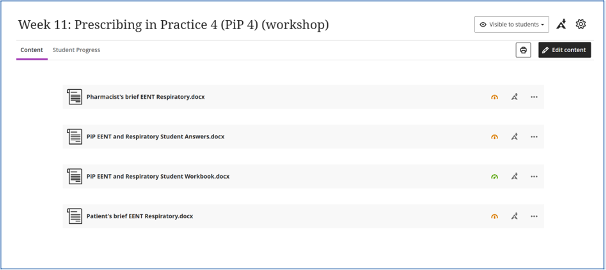
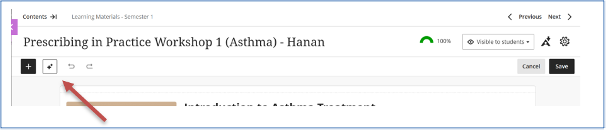
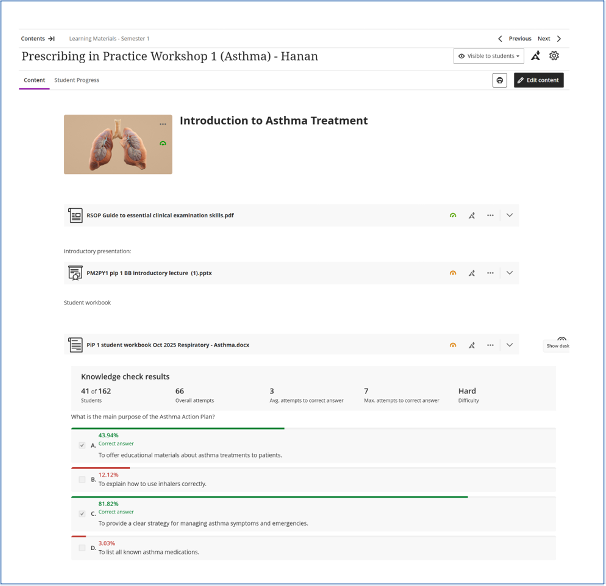
Find out how Global Academy Lecturer, Brian Turner, has used the Blackboard Socratic Questioning Chatbot feature (part of Blackboard’s AI Design Assistant) in a class, and his thinking on its broader T&L application and meta-use for multiple T&L outcomes.
Overview
I used the Blackboard Socratic Questioning chatbot in my International Foundation Programme Academic English class (1) as a tool as part of the early stages of the process of students generating ideas for a summative essay project, and (2) for student to briefly reflect on the usefulness of the tool itself.
Objectives
- For students to use the Socratic Questioning chatbot to generate ideas for their summative essay project;
- For students to then reflect on its use and evaluate how much, if at all, it helped them,
- Brief class discussion on the two points above but also on the nature and ethics of AI.
Context
I used the Blackboard Socratic Questioning chatbot in an IF0AE2 – International Foundation Academic English class. I wanted to try it as beckoned to by a CQSD session I attended soon after it had been developed and introduced, but also to measure and evaluate student engagement with it as a new possible lesson tool.
Implementation
During Semester 2 of AY 2025-26, I used the Blackboard Socratic Questioning chatbot tool as a means for students to generate ideas in the early stages of their summative essay. Further, I also wanted them to reflect on the use and usefulness of the tool. Two prompts were set:
- Use this chatbot to work out a focus for your essay to link the theme of aesthetics to your discipline.
- In what ways did the conversation advance your understanding of the topic?
The ‘AI persona’ was set at the default basic of ‘Supportive’ to reflect the scaffolded nature of the class and indeed my pedagogic approach (plus set up was within limited time resource).
Remembering advice from the session I attended, I set ‘Complexity of responses’ at middle level to reflect an appropriate level for a language class.
Afterwards, we had a brief discussion to reflect on the activity and the tool.
Impact
There were varying degrees of engagement with the tool. 4/6 students used it, but 2 abstained, possibly as ‘conscientious objectors’. Some engagement with the first prompt was done a little ‘flippantly’…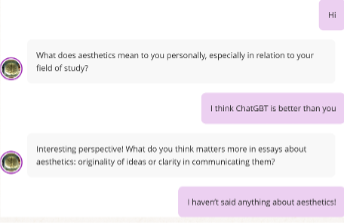
…but otherwise, it was used more in the spirit intended.
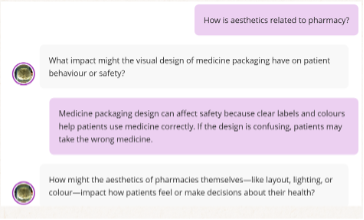
For the reflective prompt, 3 of the 4 left comments noting a positive experience. In this sense, the activity leant mostly on the side of objectives being met.

However, I also detected a slight reluctance from the students to use it again. This irony does exhibit an interesting phenomenon though, that students will vary their responses to the same event, depending on the ‘format’.
Reflections
It was successful in that most students present engaged and noted the tool’s usefulness. It also allowed discussion around the nature and ethics of AI, wherein we shared our knowledge and views on the AI phenomenon. In the future, I will dig deeper into this element.
My conscientious objectors’ reservations had environmental and data concerns. Next time however, I will be better able to signpost the TEL Guidance and UoR’s assurances RE sustainability, energy use and DP. Discussions around these issues are essential, and indeed teacher-student dialogue thereof is a vital conceptual arena and element in creating a collaborative classroom and safe space. This thus all falls within my key pedagogic approaches of student belonging, whole self teaching, exploring wider T&L opportunities and transformational leadership.
In the future, I will experiment with AI personas and the Role Play tool with an aim to improve value and engagement. In my personal use of ChatGPT, which in some instances I have turned into lesson materials to on using GenAI critically, I often have it adopt a persona or two. One example is when I had philosopher Socrates and fictional character Uhtred from The Last Kingdom books/show discuss veganism. In content lessons, to have the AI speak in the persona of someone students are studying creates great opportunities for students to assess how accurate the AI is against their knowledge of the person and their works. This is also the case with contextual information also. This are points I intend to incorporate in later uses of these tools.
Follow up
Though I was unable to develop the activity further or indeed use it or the Role Play chatbot again due to limited time resource, I have signposted them in the teacher notes of the new module materials that have been developed for AY 2026-27. Again, I intend to explore the persona function more to have students test content knowledge in their own fields. I will also give more options to the students, i.e. they can choose the kind of persona, e.g. supportive again, or perhaps authoritative, depending on what the tool allows.
Further information
CQSD TEL guidance: Blackboard AI Design Assistant AI Conversations
University of Derby: Enhancing student engagement with Blackboard’s AI Conversation Tool