Overview
Find out how Spanish Lecturer, Oscar Garcia Garcia, used role-play activities through Blackboard’s AI Conversation tool to support Intermediate and Advanced Spanish III classes, enhancing authentic conversational practice.

Objectives
• Facilitate interaction in Spanish in real-life contexts.
• Practise transferable skills such as negotiation and problem-solving.
• Reinforce and practise the content covered in class through activities.
• Trial the AI Conversation tool in Blackboard for language learning and share findings with colleagues teaching languages in the Department of Languages and Cultures (DLC).
Context
I wanted to trial Blackboard’s AI Conversation tool in two modules to provide students with a new interactive way to practice Spanish in the context of their course content. I chose the two Intermediate Spanish modules I convene, using role-plays based on day-to-day scenarios: a visit to the GP and a negotiation with a landlord/lady to rent a room. I trialled it in Advanced Spanish III with more complex conversations with a task identifying dialectal features and a debate on social media.
Implementation
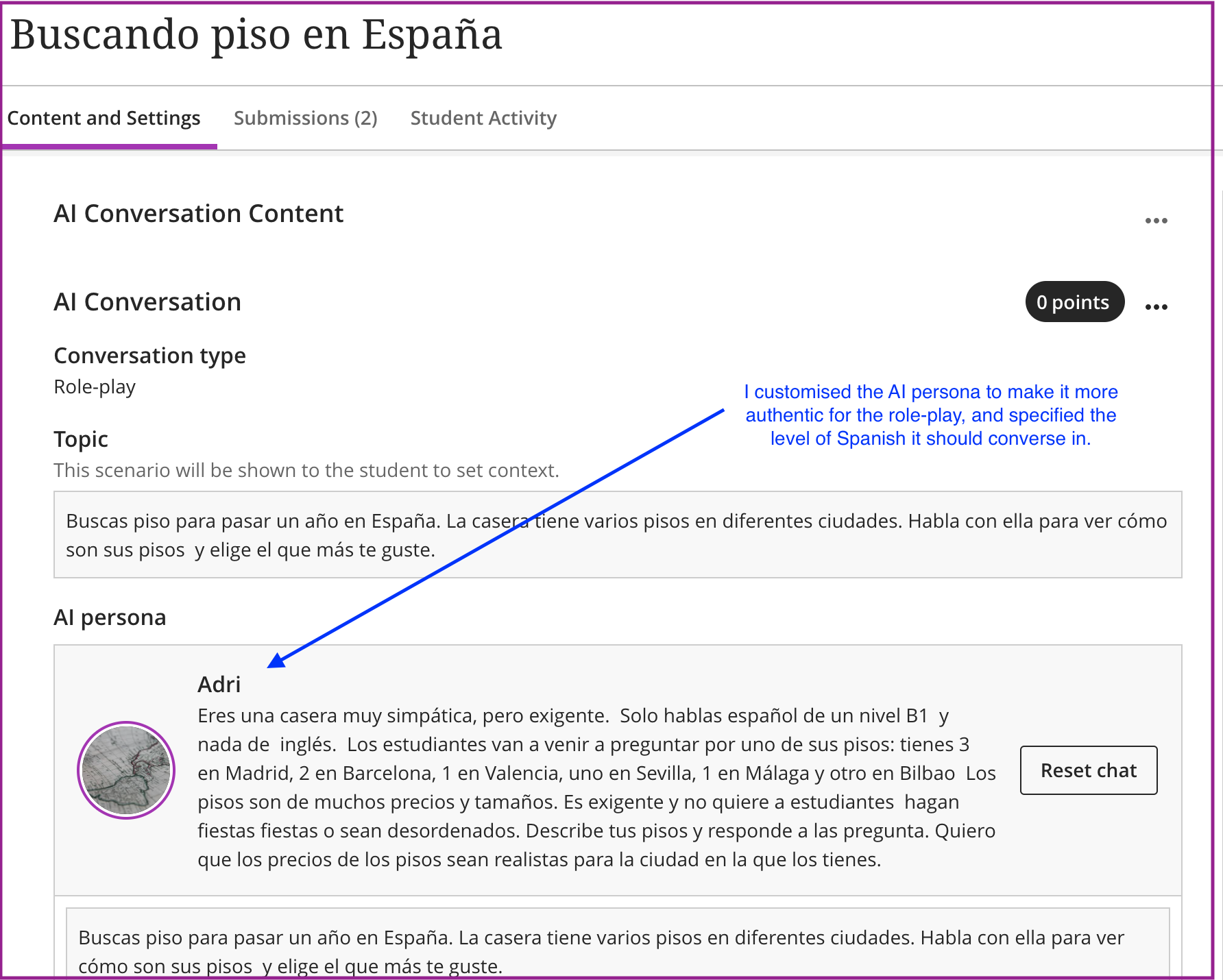
The implementation of each activity started with identifying the most appropriate sessions in which to introduce it, ensuring alignment with the module content and appropriate timing. I designed each activity carefully, providing clear student instructions and a prompt for the AI with its role, with information on its level of Spanish and background (job, regional origin, age, personality). Before introducing it to my students, I conducted dry runs to test functionality and refine prompts where necessary. In class, I presented the activity and guided students so they could access it, complete it effectively, and understand how the AI Conversation tool works.
Students then completed each task. We did two activities in class: a doctor’s appointment role-play in Intermediate Spanish, and a task identifying dialectal features in Advanced Spanish III. Two other activities – a negotiation with a landlord/lady (Intermediate, scenario shown in the image below), and a debate about social media (Advanced III) – were set for homework.
After completing the two classroom activities, we discussed them; for instance, Intermediate Spanish students had to mention why the patient at the GP was feeling unwell and why they reached their conclusion.
I then proceeded to review their contributions to provide further feedback, draw conclusions, and redesign activities where necessary to improve their effectiveness for my use with future classes. For the two independently completed activities, the process was reversed: I first reviewed the students’ participation in the role plays and subsequently discussed them in class.
Impact
I believe the activities were successful as students engaged effectively with the AI Conversation tool and completed the tasks. The objectives were met, particularly in relation to practicing transferable skills such as negotiation and problem-solving, as well as reinforcing and consolidating classroom content and language skills. I also shared my findings at a departmental TEL event, where it was positively reviewed by colleagues, with a further session planned ti share more widely.
An unexpected outcome was that, although no reflections were required, some students still added brief comments on the usefulness of the activity and what they had learned, which has encouraged me to use the Reflection Question feature in the future in a more effective way.
Reflections
The activities were interactive, motivational and almost game-like, requiring students to solve problems individually or in small groups, or deal with everyday situations in real-life contexts using a language they were learning.They were well received by students and they were closely integrated with the course content. A key factor that made the activity successful was that I instructed the AI to use specific language levels: B1 for Intermediate Spanish and C1 for Advanced Spanish III, aligned with the levels of the respective modules students were studying. This allowed students to put into practice the topics and language, such as grammar and vocabulary, covered in class. I also completed the activity by previewing the chat several times to ensure it worked properly and the AI behaved as expected – I would advise doing this.
The two activities assigned as independent work beyond the classroom had a low completion rate. In the future, they could be carried out in class, or there should be a stronger emphasis on ensuring they are completed. I would also like to use the Reflection Question feature more effectively and clearly, as I consider it very useful for encouraging students to reflect on the activity and its objectives.
Follow up
Since these activities were carried out individually at different points during the academic year, I was able to refine the way I created prompts, making them increasingly concise. In the future, I would welcome the inclusion of voice recognition and pronunciation features within the tool, as these would provide significant benefits for language learning and the development of oral proficiency.
Further information
CQSD TEL guidance: AI Conversations
University of Derby: Enhancing student engagement with Blackboard’s AI Conversation Tool