Daniel Grant, Associate Professor in Clinical Pharmacy & Pharmacy Education, Pharmacy Director of Teaching & Learning & Dr Taniya Sharmeen Research Fellow
Click here to read the full report.
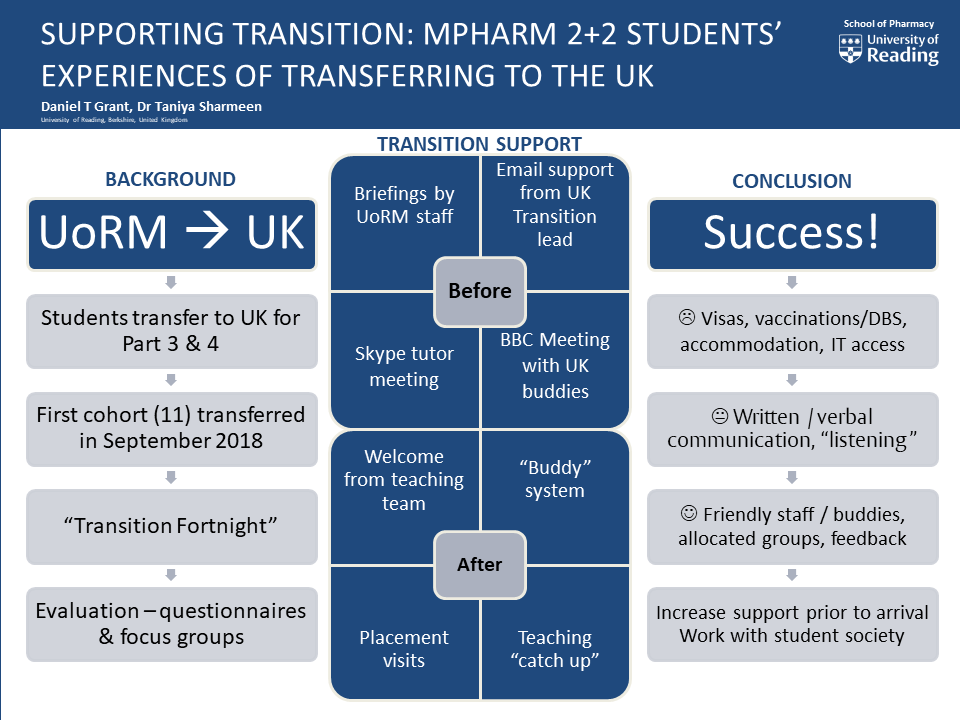
This slide summarises the project:

Centre for Quality Support and Development | The University of Reading
Daniel Grant, Associate Professor in Clinical Pharmacy & Pharmacy Education, Pharmacy Director of Teaching & Learning & Dr Taniya Sharmeen Research Fellow
Click here to read the full report.
This slide summarises the project:

Fiona Orel– International Study and Language Institute (ISLI)
ISLI’s Test of English for Educational Purposes (TEEP) is administered at the end of pre-sessional courses as a measure of students’ academic English proficiency. The speaking test has traditionally been an academic discussion between two students that is facilitated by an interlocutor and marked by an observer.
This case study outlines the process of creating a version of the TEEP speaking test for 1-1 online delivery.
The Pre-sessional English course 3 (PSE 3) started in April during the period of lockdown. At the end of the course all students sit a TEEP test which includes a test of speaking skills. We realised that we wouldn’t be able to administer the usual two student + two teachers test given the constraints with technology and the changes in teaching and learning which reduced to a certain degree the students’ opportunities for oral interaction and that we would need to develop a new 1-1 test that maintained the validity and reliability of the original TEEP Speaking test.
We had two main objectives: to create a valid online 1-1 speaking test, and to make sure that the technology we used to administer the test was simple and straight-forward for both teachers and students, and would have reasonably reliable connectivity in the regions where students were based (China, Middle East and UK).
The first thing we needed to do was to return to our test specifications – what exactly were we hoping to assess through the oral exam? The original face-to-face test had five criteria: overall communication, interaction, fluency, accuracy and range, and intelligibility. We knew that interaction had been impacted by the move online, but decided that the aspect of responding appropriately to others was a crucial aspect of interaction that needed to remain and included this in the ‘overall communication’ criteria. Recognising also that interlocutors would also need to be examiners, we worked on streamlining the criteria to remove redundancy and repetition and to ensure that each block contained the same type of description in the same order thereby making it easier for tutors to skim and recall.
We then worked out exactly what functions and skills in speaking that we wanted to test and how we could do that while mostly working with existing resources. We aligned with the original test specifications by testing students’ ability to:
The test format that enabled this was:
The final stage was trialling a platform to conduct the tests. We had considered Zoom due to its reliability but discounted it due to security concerns. BB Collaborate had connectivity issues in China so we decided to use Teams as connectivity was generally better and students and teachers were familiar with the platform as they had been using it for tutorials. Due to the spread of students over time zones, we decided to spread the speaking tests over three mornings finishing by 11:00 BST on each day. We kept the final slot on Friday free for all teachers to enable rescheduling of tests for any student experiencing issues with connectivity on the day.
Finally, we needed to help teachers and students prepare for the tests. For students, learning materials were produced with videos of a sample test, there was a well-attended webinar to introduce the format and requirements, and the recording of this webinar was made available to all students along with a document on their BB course. This instructed them what to do before test day and what to expect on test day.
The test format and procedures were introduced to teachers with instructions for tasks to do before the test, during the test, and after the test. There was also an examiner’s script prepared with integrated instructions and speech to standardise how the tests were administered. Each test was recorded to ensure security and to enable moderation. All students had to verify their identity at the start of the test. The test recording caused some problems as we knew that the video would have to be downloaded and deleted from Stream before anyone else or the student in the Team meeting who had been tested could access it. For this reason we allowed 40 minutes for each 20 minute interview as downloading was sometimes a lengthy process depending on internet speeds. We had 2 or 3 people available each day to pick up any problems such as a teacher being unwell or having tech issues, and/or a student experiencing problems. This worked well and on the first two days we did have to reschedule a number of tests, fortunately, all worked well on the final day. The teachers were fully committed and worked hard to put students at ease, informal feedback from students was the appreciation of an opportunity to talk 1-1 with a tutor, and tutors said that the test format allowed for plenty of evidence upon which to base a decision.
The test was successful overall and there were fewer technical issues than we had anticipated. Teachers and students were happy with it as an assessment measure and we were able to award valid and reliable grades.
Working together collaboratively with the teachers and the Programme Director was incredibly rewarding and meant that we had a wide resource base of talent and experience when we did run into any problems.
Incredibly detailed planning, the sharing of information across Assessment and Pre-sessional Teams, and much appreciated support from the TEL team helped to make the test a success. Students and teachers had very clear and detailed instructions and knew exactly what was expected and how the tests would be conducted. The sharing of expertise across teams meant that problems were solved quickly and creatively, and it is good to see this practice becoming the norm.
We need to work on the issue of downloading and deleting the video after each test as this caused some anxiety for some teachers with slower internet connection. We also need to have more technical support available, especially on the first day. Most students had tested their equipment as instructed but some who hadn’t experienced issues. It would be even better if a similar activity could be built into the course so that teachers and students experience the test situation before the final test.
ISLI’s Assessment Team is now preparing to administer the same tests to a much larger cohort of students at the end of August. We will apply the lessons learned during this administration and work to make the process easier for teachers.
Dr Edward Tew – Lecturer in Accounting, HBS.
Due to the COVID-19 pandemic, many of us in UoR moved to ‘emergency’ remote teaching at the end of the spring term. Colleagues across the university were developing instruction using VLE platforms such as UoR Blackboard and students were studying and working online at a distance.
At the same time, we are urged to use different ways to provide meaningful online learning. In response, UoR has recently published a Teaching and Learning Framework for Autumn 2020 intending to balance the online delivery with interacting teaching. One particular point to note is that this framework is “influenced by pedagogical approaches used in flipped learning” (UoR, 2020). With this in mind, I thought of sharing with you my reflection on the Flipped learning, particularly on the framework proposed by Flipped Learning Network (FLN) (2014) and its application during this Covid-19 pandemic.
According to FLN’s (2014) definition, flipped learning is:
“a pedagogical approach in which direct instruction moves from the group learning space to the individual learning space, and the resulting group space is transformed into a dynamic, interactive learning environment where the educator guides students as they apply concepts and engage creatively in the subject matter.”
With this definition, the flipped learning /classroom is built around the four “pillars” F- flexible environment, L- learning culture, I- intentional content, and P- professional educator (Flipped Learning Network, 2014). I believe these four “pillars” can be applied in online flipped lessons which students learn either synchronously or asynchronously. To meet the demand for distance/online learning, especially given the current pandemic, I hope to share my reflection on the use of flipped learning by considering the four pillars accordingly.
In this pillar, educators allow a variety of learning modes in which students choose when and where they learn either group work or independent study.
Application: Select a platform that will be the hub of your online classroom and for all your instructional activities and resources. In my module, I stick to use the Blackboard (BB) as my core online learning platform with students. Don’t be afraid to be experimental and mix the available tools on the BB, such as wikis to upload students’ group work, presentations, and research activities. There are many other platforms available such as Google Classroom, Microsoft Teams, Webex. The key is to use what is already familiar to students so that the learning process and activities are made easier for them to navigate and participate effectively.
The learning culture in flipped learning has shifted the traditional teacher-centred model to a learner-centred approach. As a result, students are actively involved in knowledge construction as they participate in and evaluate their learning in a personally meaningful manner.
Application: Once you’ve chosen your platform, decide how you will organise learning to encourage a learner-centred learning culture. To do this, communication is the key. In my module, I made sure the module was easy to navigate. I made sure the learning aims and objectives are clearly stated so students can see what they were learning for each topic/ lesson. I also made use of the BB’s module page with folders created to indicate my teaching materials, learning activities and presentations etc. Next, I tried to encourage collaboration in learning using tools such as discussion boards, wikis, blogs or online meetings (i.e. WhatsApp, Team, Zoom). These would provide user-friendly spaces to get my students to work collaboratively and sharing ideas. With all these tools, I have constantly made it clear that students were expected to do their learning first before coming to meet together for critical discussion and interaction.
In this pillar, educators decide what they need to teach and what materials students should explore on their own. This pillar aims to maximise classroom time to encourage student-centred learning as considered in pillar 2 above.
Application: Intentional learning occurs when we purposefully select and deliver the content to actively engage students in learning. In my module, I always leave a ‘gap’ for students to further explore and research the subject topic in a group or individually. I used the discussion board and wikis to see their collaborative work and research on the subject matter. I also made sure they could apply what they have learned in an assigned case study. I intentionally used the assessment strategies that test students’ ability to conduct their research and critical thinking. Textbook’s resources and library learning resources are particularly useful in this respect.
FLN (2014, p.2) proposes that “Professional Educators are reflective in their practice, connect with each other to improve their instruction, accept constructive criticism, and tolerate controlled chaos in their classrooms. While Professional Educators take on less visibly prominent roles in a flipped classroom, they remain the essential ingredient that enables Flipped Learning to occur.”
Application: The teacher’s role in an online flipped classroom is to facilitate learning as in a physical classroom. In this case, it means it is essential to be available to your students virtually, providing instructional support and feedback. In my module, I monitored the online discussion board and provided feedback promptly. I also used BB Collaborate to have 1-2-1 and group sessions with students to moderate students’ learning progress and provide constructive feedback.
This is a challenging time for numerous reasons particularly the anxiety of the unknown surrounding the virus. Given the current situation under the COVID-19 crisis, implementing online flipped learning/classroom makes sense so students do not fall behind in their learning. However, barriers and challenges to develop an effective one must be acknowledged. In this view, I resonate with FLN’s (2014) quote for Professional educators above as I need to be agile and robust to improve my instructional strategies, accept constructive criticism, and welcome controlled chaos in this online flipped classrooms. We must adapt, change quickly and moving forward effectively to counter the challenges in this unprecedented time.
References:
Flipped Learning Network (FLN). (2014) The Four Pillars of F-L-I-P™ , Reproducible PDF can be found at www.flippedlearning.org/definition.
UoR (2020) Teaching and Learning: Framework for Autumn term 2020, available at: https://www.reading.ac.uk/web/files/leadershipgroup/autumn-teaching-proposal-v11.pdf
Madeleine Davies, Cindy Becker and Michael Lyons- SLL
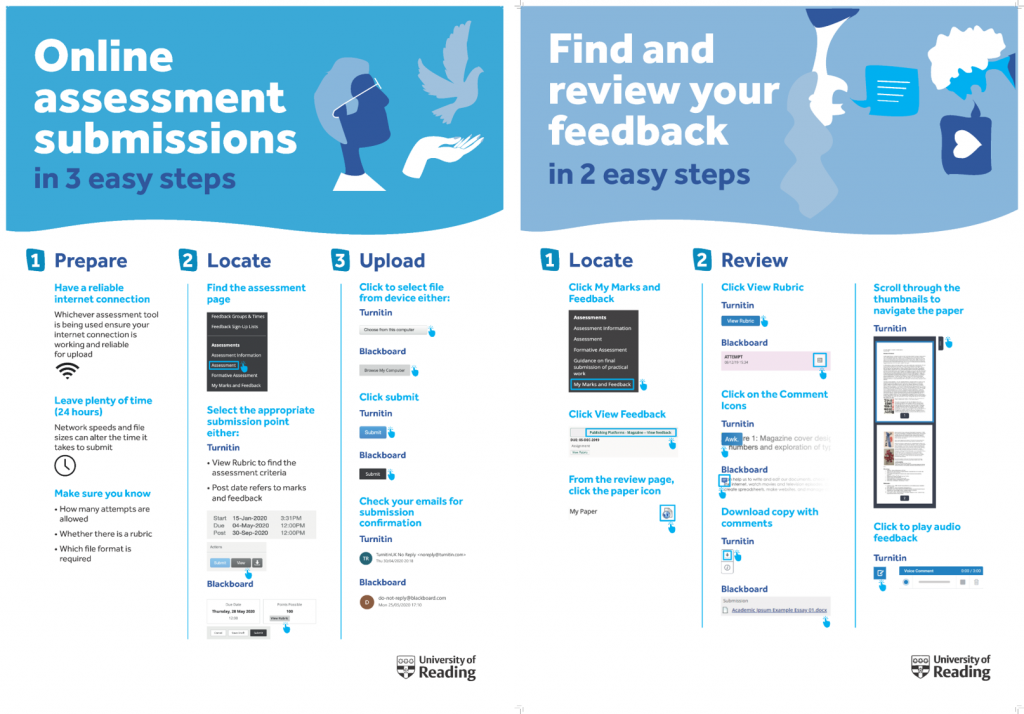
A feedback audit and consultation with the Student Impact Network revealed a set of practices DEL needs to amend. The research produced new student-facing physical and online posters, designed by a ‘Real Jobs’ student, to instruct students on finding their feedback online, and generated ‘marking checklists’ for staff to indicate what needs to be included in feedback and what needs to be avoided.
The ‘DEL Feedback Action Project’ addresses the persistent issue of depressed NSS responses to Department of English Literature assessment and feedback practices. The responses to questions in ‘teaching quality’ sections are favourable but the 2018 NSS revealed that, for English Studies, Reading is in the third quartile for the ’Assessment and Feedback’ section and the bottom quartile for question 8 (scoring 64% vs the 74% median score) and question 9 (scoring 70% vs the 77% median score).
In October 2018, DEL adopted eSFG. An EMA student survey undertaken in January 2019 polled 100 DEL students and found that, though students overwhelmingly supported the move to eSFG, complaints about the quality of DEL feedback persisted.
Michael Lyons began the project with an audit of DEL feedback and identified a number of areas where the tone or content of feedback may need improving. This material was taken to the Student Impact Network which was shown anonymised samples of feedback. Students commented on it. This produced a set of indicators which became the basis of the ‘marking checklist’ for DEL staff. Simultaneously, DEL staff were asked to discuss feedback practice in ‘professional conversations’ for the annual Peer Review exercise. This ensured that the combined minds of the whole department were reflecting on this issue
Student consultation also revealed that many students struggle to find their feedback online. With this in mind, we collaborated with TEL to produce ‘maps to finding feedback’ for students. A ‘Real Jobs’ student designer converted this information into clear, readable posters which can be displayed online or anywhere in the University (the information is not DEL-specific). The posters will be of particular use for incoming students but our research also suggested that Part 3 students are often unaware of how to access feedback.
The results of the initial audit and consultation with students indicated where our feedback had been falling short. We wrote a summary of these finding for DEL HoD and DDTL.
Research into marking rubrics revealed that DEL marking would not be suited to using this feedback practice. This is because they can be inflexible and because DEL students resist ‘generic’ feedback.
ImpactThe student-facing posters and staff-facing ‘marking checklist’ speak to two of the main issues with DEL feedback that were indicated by students. The latter will deter overly-brief, curt feedback and will prompt more feedforward and comment about specific areas of the essay (for example, the Introductory passage, the essay structure, referencing, grammar, use of secondary resources, etc).
With DEL staff now focused on the feedback issue, and with students equipped to access their feedback successfully, we are hoping to see a marked improvement in NSS scores in this area in 2020-21.
For ‘surprises’, see ‘Reflections’.
The pressure on academic staff to mark significant amounts of work within tight deadlines can lead to potential unevenness in feedback. We are hoping that our research prompts DEL to streamline its assessment practice to enhance the quality and consistency of feedback and feedforward.
Students’ responses in the Student Impact Network also suggested that additional work is required on teaching students how to receive feedback. Over-sensitivity in some areas can produce negative scores. With this in mind, the project will terminate with an equivalent to the ‘marking checklist’ designed for students. This will remind students that feedback is anonymous, objective, and intended to pave the way to success.
Monitoring NSS DEL feedback scores in the 2020-21 round, and polling students in the next session to ensure that they are now able to access their feedback.
Continuing to reflect on colleagues’ marking workload and the link between this and unconstructive feedback.
Dr Rachel Horton, School of Law
The PLaNT project involved the co-creation, with students, of a series and podcasts and other materials for Contract Law (LW1CON). Student leaders consulted with their peers to decide what materials students felt would most enhance learning on the module and then created these together with the Module Convenor.
This project aimed to engage current law students as co-creators of course learning material.
Contract Law is a large compulsory first year module – in an average year between 250 and 300 students take the module – taught using a traditional combination of lectures and small group teaching. Module staff were keen to develop additional resources for students to access, in their own time, through Blackboard and wanted to engage students in developing these.
Staff met with selected students to introduce a student curated Blackboard space, in which the students had authoring permissions to generate podcast feeds, which would be accessible to all students enrolled on the module. These students were then asked to consult with their peers to generate ideas for use of the space/topics for the podcasts.
The student leaders then created a series of podcasts, largely focusing on revision materials and assessment and exam technique by interviewing lecturers on the module. The students also devised and created a series of written materials, in a variety of formats, and lecturers provided feedback on these (chiefly to ensure accuracy) before they were uploaded onto Blackboard.
The student leaders were highly engaged and enthusiastic and went well beyond their original remit in devising course content. They fed back, informally, that they had found the experience immensely beneficial to their own learning, as well as giving them the opportunity to develop a range of leadership, technical and communication skills.
Statistics on Blackboard showed that the materials were well used by the rest of the cohort, particularly in the immediate run up to the exams. While it proved difficult to recruit students for a focus group after the project had finished, in order to gain more structured feedback, student representatives commented at the Staff Student Liaison Committee that they had received very positive feedback from students about the additional materials created through the project.
The success of the activity was largely a result of the enthusiasm, imagination and commitment of the students involved. We were lucky to recruit students who were able to work very well together, and with their peers, to create resources to genuinely enhance learning, and to fill gaps in course materials that may otherwise have gone unnoticed by staff.
The project also offered an opportunity for the teaching staff on the module to reflect on the content and format of materials students want. Even after the funded project has finished this proved very helpful in enabling us to continue to produce similar materials, particularly once teaching had to move online in the wake of COVID-19.
The project and funding began in the Spring term and with hindsight it would have been beneficial to start the project earlier in the course. In particular this would have provided opportunity for gathering more structured feedback from the whole cohort (it was difficult to secure a meaningful student response to feedback once the summer exams were over.)
The materials produced by the students remain relevant for future cohorts and will continue to be made available. New materials will be developed along similar lines, with student input wherever possible, particularly next year as lectures move wholly online.
Daniela Standen, ISLI
ISLI teaches almost exclusively international students. Many of our programmes run all year round, so ISLI had to move to teach exclusively online in the Summer Term. This case study outlines the approach taken and some of the lessons learnt along the way.
In April 2020 as the country was into lockdown and most of the University had finished teaching, ISLI was about to start a ‘normal’ teaching term. The Pre-sessional English Programme was about to welcome 100 (mostly new) students to the University. The January entry of the International Foundation Programme was less than half-way through their studies and the Academic English Programme was still providing language and academic literacy support to international students.
Moving to online teaching was greatly facilitated by having in house TEL expertise as well as colleagues with experience of online teaching, who supported the upskilling of ISLI academic staff and were able to advise on programme, module and lesson frameworks.
We thought that collaboration would be key, so we put in place numerous channels for cross-School working to share best practice and tackle challenges. ISLI TEL colleagues offered weekly all School Q&A sessions as well as specific TEL training. We set up a Programme Directors’ Community of Practice that meets weekly; and made full use of TEAMS as a space where resources and expertise could be shared. Some programmes also created a ‘buddy system for teachers’.
Primarily the School adopted an asynchronous approach to teaching, synchronous delivery was made particularly difficult by having students scattered across the globe. We used a variety of tools from videos, screencasts, narrated PowerPoints and Task & Answer documents to full Xerte lessons. Generally using a variety of the above to build a lesson. Interactive elements were provided initially mostly asynchronously, using discussion boards, Padlet and Flipgrid. However, as the term progressed feedback from students highlighted a need for some synchronous delivery, which was carried out using Blackboard collaborate and TEAMS.
It has not been easy, but there have been many positive outcomes from having had to change our working practices. Despite the incredibly short timescales and the almost non-existent preparation timel, our PSE 3 students started and successfully finished their programme completely online, the IFP January entry students are ready to start their revision weeks before sitting their exams in July and international students writing dissertations and post graduate research were supported throughout the term.
As a School we have learnt new skills and to work in ways that we may not have thought possible had we not been forced into them. These new ways of working have fostered cross-School collaboration and sharing of expertise and knowledge.
We have learnt a lot in the past three months. On average it takes a day’s work to transform one hour of face to face teaching into a task-based online lesson.
Not all TEL tools are equally effective and efficient, below are some of our favourites:
If time were not a consideration Xerte would also be on the list.
Copyright issues can have a real impact on what you can do when delivering completely online. Careful consideration also needs to be given when linking to videos, particularly if you have students that are based in China.
ISLI is now preparing for Summer PSE, which starts at the end of June. Many of the lessons learnt this term have fed into preparation for summer and autumn teaching. In particular, we have listened to our students, who told us clearly that face-to-face interaction even if ‘virtual’ is really important and have included more webinars and Blackboard Collaborate sessions in our programmes.
Dr Karin Whiteside, ISLI
Alongside its embedded discipline-specific provision, the Academic English Programme (AEP) offers a range of open sign-up academic language and literacy courses each term. This case study outlines the process of rapidly converting the summer term provision online, and reports student feedback and reflections on the experience which will help inform continued online delivery this autumn term.
Our aim was to provide academic language and literacy support which, as far as practicably possible, was equivalent in scope and quality to our normal face-to-face offering for the same time of year. In summer term, our provision is particularly important for master’s students working on their dissertations, with high numbers applying for Dissertation & Thesis Writing, but courses such as Core Writing Skills and Academic Grammar also providing important ‘building block’ input needed for competent research writing.
Prior to the COVID crisis, our face-to-face courses on different aspects of written and spoken Academic English have been offered for open application on a first-come-first served basis, with a rolling weekly waiting list. With a maximum of 20 students per class, we have been able to offer interactive, task-based learning involving analysis of target language and communicative situations in context, practice exercises and opportunity for discussion and feedback within a friendly small-group environment.
Within an extremely tight turnaround time of four weeks to achieve this, we determined a slightly slimmed down programme of five ‘open-to-all’ online courses – Academic Grammar, Core Academic Writing Skills, Dissertation & Thesis Writing, Essays: Criticality, Argument, Structure and Listening & Note-taking – and replaced our normal application process with self-enrolment via Blackboard, meaning uncapped numbers could sign up and have access to lessons.
Time restraints meant we had to be pragmatic in terms of where to focus our energies. Conversion of course content online needed to be done in a way that was both effective and sustainable, thinking of the potential continued need for online AEP provision going into 2020/21. We predicted (rightly!) that the process of initially converting small-group interactive learning materials to an online format in which their inductive, task-based qualities were retained would be labour-intensive and time-consuming. Therefore, for the short term (summer 2020) we adopted a primarily asynchronous approach, with a view to increasing the proportion of synchronous interactivity in future iterations once content was in place. In terms of converting face-to-face lessons to online, we found what often worked most effectively was to break down contents of a two-hour face-to-face lesson into 2-3 task-focused online parts, each introduced and concluded with short, narrated PowerPoints/MP4 videos. We determined a weekly release-date for lesson materials on each course, often accompanied by a ‘flipped’ element, labelled ‘Pre-lesson Task’, released a few days prior to the main lesson materials. We set up accompanying weekly Discussion Forums where students could ask questions or make comments, for which there was one ‘live’ hour per week. Apart from Pre-Lesson Tasks, task answers were always made available at the same time as lessons to allow students complete autonomy.
Moving rapidly to online delivery meant not necessarily having the highest specification e-learning tools immediately to hand but instead working creatively to get the best out of existing technologies, including the Blackboard platform, which prior to this term had had a mainly ‘depository’ function in AEP. To ensure ease of navigation, the various attachments involved in creating such lessons needed to be carefully curated by Folder and Item within BB Learning Materials. Key to this was clear naming and sequencing, with accompanying instructions at Folder and Item level.
Positive outcomes of taking the summer AEP provision online have included noticeably higher uptake (e.g. in Academic Grammar, 92 self-enrolments compared to 30 applications in summer term 2018/19) and noticeably higher real engagement (e.g. with an average of 11 students attending the 2018/19 summer face-to-face Academic Grammar class, compared to a high of 57 and average of 38 students accessing each online lesson). Running the courses asynchronously online has meant no waiting lists, allowing access to course content to all students who register interest. It also means that students can continue to join courses and work through materials over the summer vacation period, which is particularly useful for international master’s students working on Dissertations for September submission, and for cohorts overseas such as the IoE master’s students in Guangdong.
In survey responses gathered thus far, response to course content has been largely positive: “It provided me an insight into what is expected structure and criticality. Now that I am writing my essay, I could see the difference”. Students appreciated teacher narration, noticing if it was absent: “I would prefer our teacher to talk and explain the subject in every slide.” The clarity of lesson presentation within Blackboard was also noted: “I think the most impressive part in this course is the way these lessons were arranged in BB as every lessons were explicitly highlighted, divided into parts with relevant tasks and their answers. Thus, I could effectively learn the content consciously and unconsciously.”
There were a range of reactions to our approach to online delivery and to online learning more generally. 52% of students were happy with entirely asynchronous learning, while 48% would have preferred a larger element of real-time interactivity: “Although this lessons ensured the freedom in dealing with the material whenever it was possible, the lack of a live-scheduled contact with the teacher and other students was somewhat dispersive.”; “I prefer face to face in the classroom because it encourages me more to contribute”. In normal circumstances, 34% of students said they would want entirely face-to-face AEP classes, whilst 21% would want a blended provision and 45% would prefer learning to remain entirely online, with positive feedback regarding the flexibility of the online provision: “it’s flexible for students to do it depending on their own time.”; “Don’t change the possibility to work asynchronously. It makes it possible to follow despite being a part time student.” Going forward, we plan to design in regular synchronous elements in the form of webinars which link to the asynchronous spine of each course to respond to students’ requests for more live interactivity. We also plan to revisit and refine our use of Discussion Forums in Blackboard. Whilst engagement of lesson content was high, students made limited use of Q&A Forums. It is hoped that more targeted forums directly linked to flipped tasks will encourage greater engagement with this strand of the online delivery in the future.
The AEP website ‘Courses, Workshops and Webinars’ page, which gives details of this summer term’s courses and what will be on offer in autumn: http://www.reading.ac.uk/ISLI/enhancing-studies/academic-english-programme/isli-aep-courses.aspx
Allán Laville (Dean for D&I and Lecturer in Clinical Psychology) and Libby Adams (Research Assistant), SPCLS
This project aimed to design a new alternative assessment to form a part of the MSci Applied Psychology course which puts emphasis on the practical sides of training as a Psychological Wellbeing Practitioner (PWP). This included utilising problem-solving skills and wellbeing strategies.
The above project was undertaken as within IAPT, Psychological Wellbeing Practitioners (PWPs) are required to work in a fast-paced environment seeing multiple patients back-to-back throughout the day. Students on the MSci Applied Psychology course are required in their third year to undertake a work placement 1 day a week in the first term increasing to 2 days a week in the second term. Students are also required to undertake 1 full day of training per week. The aim of the project was to embed an assignment which focusses on managing wellbeing within the curriculum.
Allán Laville (Dean for Diversity and Inclusion) brought to light the concept of incorporating wellbeing within the curriculum and contacted Libby Adams (Part 4 MSci Student) to see whether she would take part in the development of the new assessment. Libby Adams was included here as she previously trained as a Psychological Wellbeing Practitioner and first-hand experienced challenges managing the demands of the PWP role as a trainee and in turn managing her wellbeing.
Libby Adams’ experience
The project was developed with my own challenges in mind, to build upon this we then met with current and past MSci students to gain insight into the challenges they faced. We were then able to condense information and incorporate them within our concept of a wellbeing blog. We then considered how we could problem-solve ways around the areas that could not be included in the blog. At the second stage we met with clinical staff and educators to share our idea and gain feedback on the feasibility of implementation within IAPT services. The final project design was then formed with the above feedback in mind.
Views from current MSci students on the benefits of the project:
“I think maintaining our own wellbeing is such a critical part of caring professions, and I think that making it a clear and mandatory part of the course you’re not only helping students look after themselves for this year, but also for their future careers as well.”
Relating to the outlined objectives the project successfully designed a prototype assessment which considers the importance of maintaining wellbeing and utilising problem-solving skills. The project will have a positive impact on the individual not only in their placement year but also if they choose to go into a clinical career after university as skills are transferable.

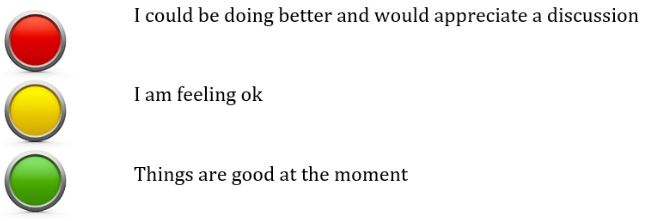
Traffic Light Mood Tracker
Students are required to complete the traffic light system to indicate how they are currently managing their wellbeing. They are required to complete these three times for each blog, once before the reflection, after they have built an action plan based on their reflection and then in the last term of the academic year reflecting on their progress.
Allán Laville’s reflections:
The project addressed a key consideration within both University training as well as within the psychological workforce, namely, the importance of explicitly considering the wellbeing of our practitioners and therapists. I am delighted with the outcome of the project and it would not have been possible without Libby. Her commitment to psychological therapies and intrinsic motivation to support others, always shines through!
Libby Adams’ reflections:
The student-staff partnership is key to improving the overall teaching and learning experience. The partnership allows the member of staff to lead as the expert by knowledge and the student to lead as the expert by experience. Such partnerships allow the development of concepts and improvements in teaching and learning which enhance the student and staff experience.
In the future we aim to share our findings with other MSci courses and IAPT services with an aim to increase conversations about practitioner wellbeing and highlight its importance within clinical roles. We hope that strategies used in this project can extend beyond students and be used across IAPT services to maintain wellbeing, improve performance and decrease stress and burnout.
Professor Cindy Becker, School of Literature and Languages
One of the most difficult aspects of lockdown has been the sense of disrupted conversations: the students you wanted to remind about how to plan an essay, the query you heard in a seminar discussion that you want to answer now that you have thought about it. For me, this was more troublesome than the empty corridors as students started to leave.
As lecturers, our whole lives are run to the rhythm of academic terms, and so to have ‘term’ still happening when I was stuck at home seemed like a daily set of missed opportunities, which led, inevitably, to increased anxiety about how my students were doing and how they could prepare well for the challenges ahead. Of course, I was not alone in this; we all felt it and found different ways to resolve that niggling feeling of unfinished business.
I realised that I needed to find a way to stay in touch with students, not just those who I would meet online as part of online teaching and formal meetings, but also those who might be worried but who would not know quite where to turn. Perhaps more important than that, I wanted to reassure students that we are still here, we still want to teach them, and we are as keen to stay in touch as they are.
From a teaching perspective, I also saw this as an opportunity to help students with some of wider aspects of learning and of assessment, rather than focusing just on subject specific material.
I set up a YouTube channel, called Still Learning Together, and then, over the course of a month, I uploaded short screencasts to the channel three times a week. I thought it important that we stayed in touch when there were no scheduled activities, so I ran this project over the Spring vacation.
The screencasts covered a range of areas:
Still Learning Together: Eight things we do not need in an unseen exam answer
Still Learning Together: Five memory techniques
Still Learning Together: Ten things at the start of an exam
Still Learning Together: Seven fixes for writer’s block
Still Learning Together: Six rehearsals for a great presentation
Still Learning Together: Four thoughts on primary and secondary sources
Still Learning Together: Three fixes for a comma splice
Still Learning Together: Six steps to calmness
Still Learning Together: Five ways to conquer reading lists
Still Learning Together: Six things you need not include in your essay
Still learning together: Four steps to semi-colons
Because I could not know which of our students might be feeling isolated or anxious at any point, I wanted to reach the widest range of students for each screencast. I used BB announcements, with email, for each year of each programme in our School. I also asked students to let me know if they would like me to make any screencasts especially for them, so some of those listed above were produced on request.
Students engaged with the resource, with more than 870 views of the channel since I created it, which I found pleasing. I am keeping my ears open for any requests for guidance from students that might be answered through future screencasts.
Our Outreach Officer, Dr Neil Cocks, sent links to the channel to some local schools with which we have relationships and received a positive response (especially to the grammar help!). We have also added them to our Literature Launchpad YouTube channel.
I am planning to develop the channel later in the summer with our Foundation Degree students in mind, so that we can put links to the channel on their central BB sites. I am also trying to think of other ways in which we might develop and use the material. We might, perhaps, include links to the screencasts as quickmarks on turnitin, or perhaps have the links as a central resource on our BB sites…
I would also like to continue to involve students, and to help them remember that we really do want to stay close to them and to keep developing their learning skills with them. I am considering how to do this, including asking students for more suggestions and boosting usage of the YouTube channel over the summer and just before the Autumn Term.
I am enjoying mulling this over from time to time, and happy to hear any suggestions from colleagues about how I might develop the channel. As with everything to do with Teaching and Learning, as soon as you think a project is finished you find a little thread leading you on to the next part of the path…one of the joys of our profession, even in lockdown.
It occurred to me that, if students have to self-isolate in the coming months, they could be left feeling a bit lost, especially if they had assumed that they would be on campus throughout the year. With this in mind, I created the following document which shows students where they can go for some instant help and support. I produced three clips and put them on the Still Learning Together YouTube channel and, although they are not the final word on online learning, they might reassure our students that we are ready to help.
If you become aware that one of your students is having to self-isolate at any point this year, you might like to send them this document.